CHAPTER 1: SENSING THE WORLD
Hier fehlt eine Einführung
DAD-001
The Multi-Antennate
(Ramificatio antennarum)
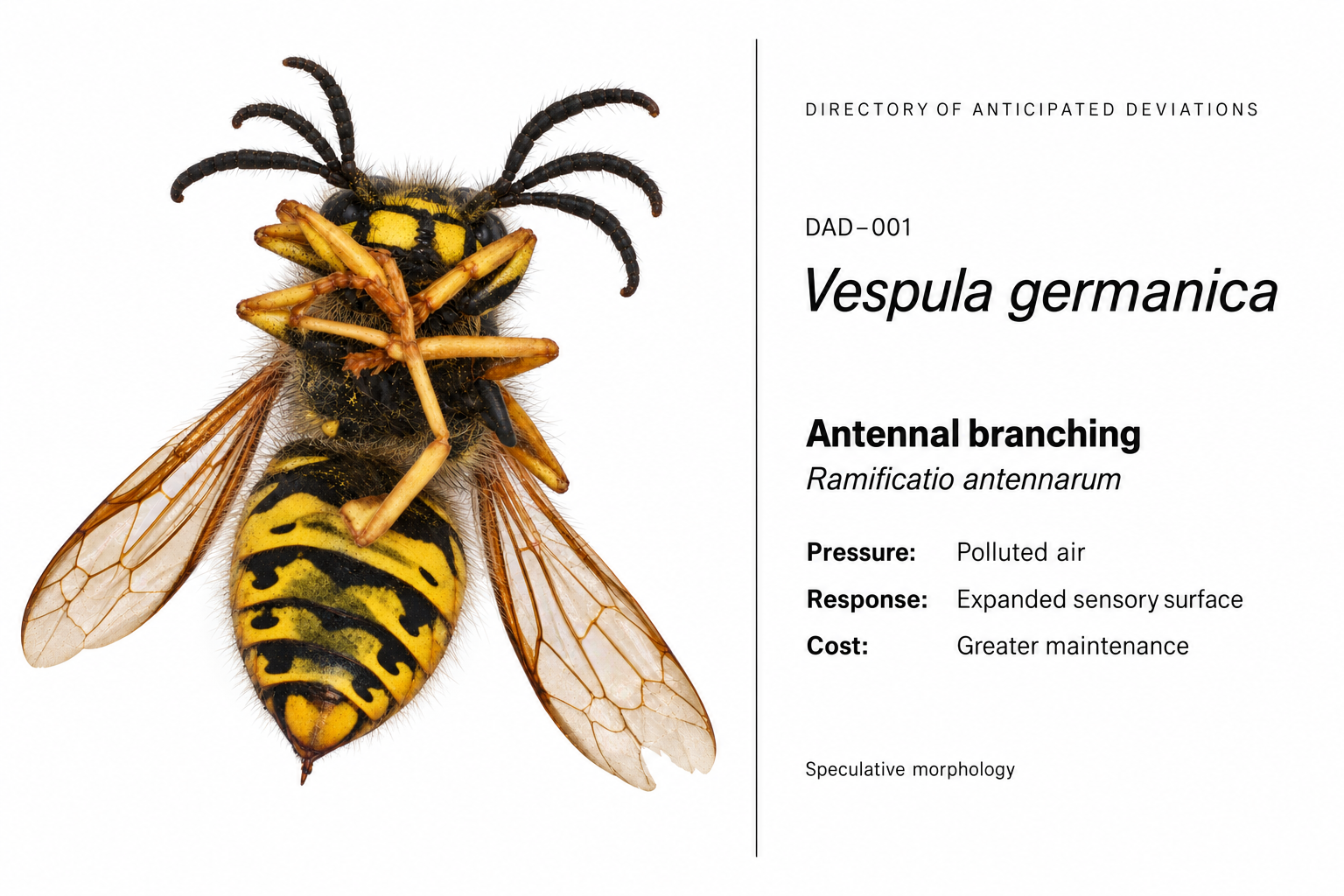
Description
In an atmosphere where pollutants alter and dissipate scent trails, the Multi-Antennate deploys a wide-reaching sensory apparatus. Its two antennae retain separate basal stalks, each dividing into three finely haired branches of unequal length. One reaches forward, while others probe to the sides or remain close to the head. Within this design, the loss of reliable chemical orientation favors an ever-expanding sensory surface: the body taps into the last discernible traces of its environment. Food, a nest, and fellow wasps are pieced together from scattered remnants. The wasp carries a delicate landscape of searching before her.
Scientific Context
It has been experimentally demonstrated that air pollution can impair chemical communication: Ozone alters sexual scent signals in fruit flies; NO₃ radicals impair flower scents and the orientation of nocturnal pollinators.¹² At the same time, tobacco hawk-moths can, under experimental conditions, learn to associate ozone-altered scent mixtures with food.³ The Multi-Antennate confronts a fundamental mismatch: a larger receptor surface area cannot retrieve information that has already been destroyed. The body invests more and more in perception, while the world becomes less and less comprehensible.
¹ ‘Ozone exposure disrupts insect sexual communication’, Nature Communications, 14 (2023), 1186. https://doi.org/10.1038/s41467-023-36534-9
² ‘Olfaction in the Anthropocene: NO₃ negatively affects floral scent and nocturnal pollination’, Science (2024). https://doi.org/10.1126/science.adi0858
³ B. Cook et al., ‘Pollination in the Anthropocene: a Moth Can Learn Ozone-Altered Floral Blends’, Journal of Chemical Ecology, 46 (2020), S. 987–996. https://doi.org/10.1007/s10886-020-01211-4
DAD-002
The Multi-Sighted
(Oculi compositi accessorii)
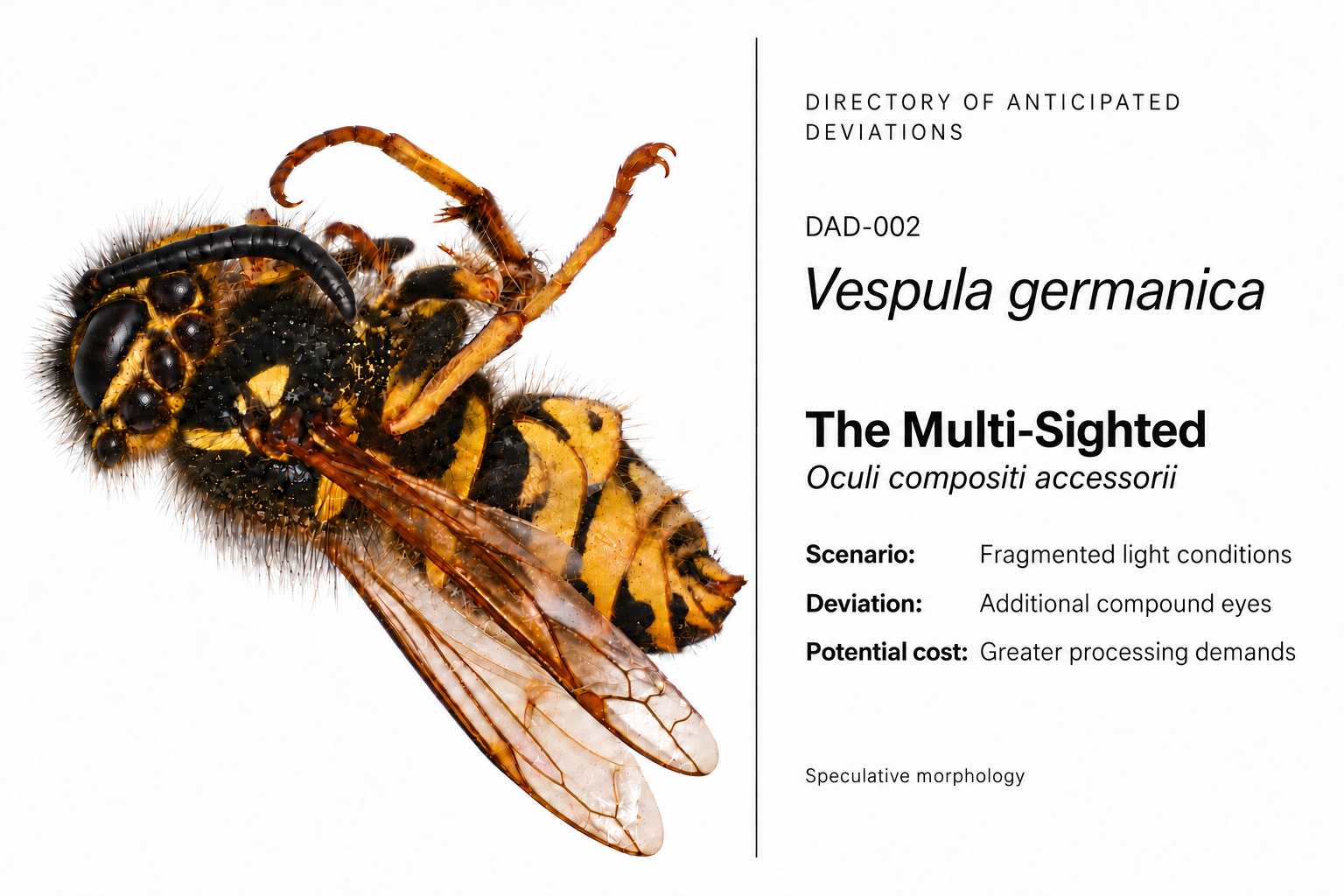
Description
Persistent daytime heat shifts foraging to twilight hours. Between artificially lit areas, dark cavities, and abrupt shadows, visual conditions change rapidly within a confined space. In this fragmented environment, the Multi-Sighted develops additional compound eyes. Small, unevenly sized eye fields cover the surface of its head, oriented laterally and diagonally upward. The head becomes a densely populated landscape of perception. Depending on their orientation, these additional eyes could register movement from more directions without requiring the wasp to turn its body. Its two antennae remain as mobile organs of smell and touch, providing information that vision cannot replace. A layered panorama emerges—but whether it offers clearer orientation depends on how these signals are brought together. Perceiving more does not necessarily mean moving through the world more safely.
Scientific Context
Extra eyes have already become a reality in developmental biology: in scarab beetles, experimental manipulation of orthodenticle activity produced additional compound eyes capable of supporting a behavioral response to light.¹ Studies of beetle head development reveal how existing genetic regulatory mechanisms can acquire new roles.² In fruit flies, targeted activation of the eyeless gene induced eye structures on the legs and wings, among other locations.³ These findings demonstrate developmental possibilities, without establishing improved navigation or greater freedom of movement. The Multi-Sighted carries this potential into an environment where perception becomes increasingly demanding. More eyes do not necessarily improve vision in darkness. Additional sensory signals must be integrated, while food and energy become scarcer. Within this body, a disturbing possibility crystallizes: the world remains visible, yet the ability to respond in time can no longer keep pace with its perception.
¹ E. E. Zattara et al., ‘Development of functional ectopic compound eyes in scarabaeid beetles by knockdown of orthodenticle’, Proceedings of the National Academy of Sciences (2017). https://pmc.ncbi.nlm.nih.gov/articles/PMC5692598/
² E. E. Zattara et al., ‘Neofunctionalization of embryonic head patterning genes facilitates the positioning of novel traits on the dorsal head of adult beetles’, Proceedings of the Royal Society B (2016). https://pmc.ncbi.nlm.nih.gov/articles/PMC4947891/
³ G. Halder, P. Callaerts und W. J. Gehring, ‘Induction of ectopic eyes by targeted expression of the eyeless gene in Drosophila’, Science (1995). https://pubmed.ncbi.nlm.nih.gov/7892602/
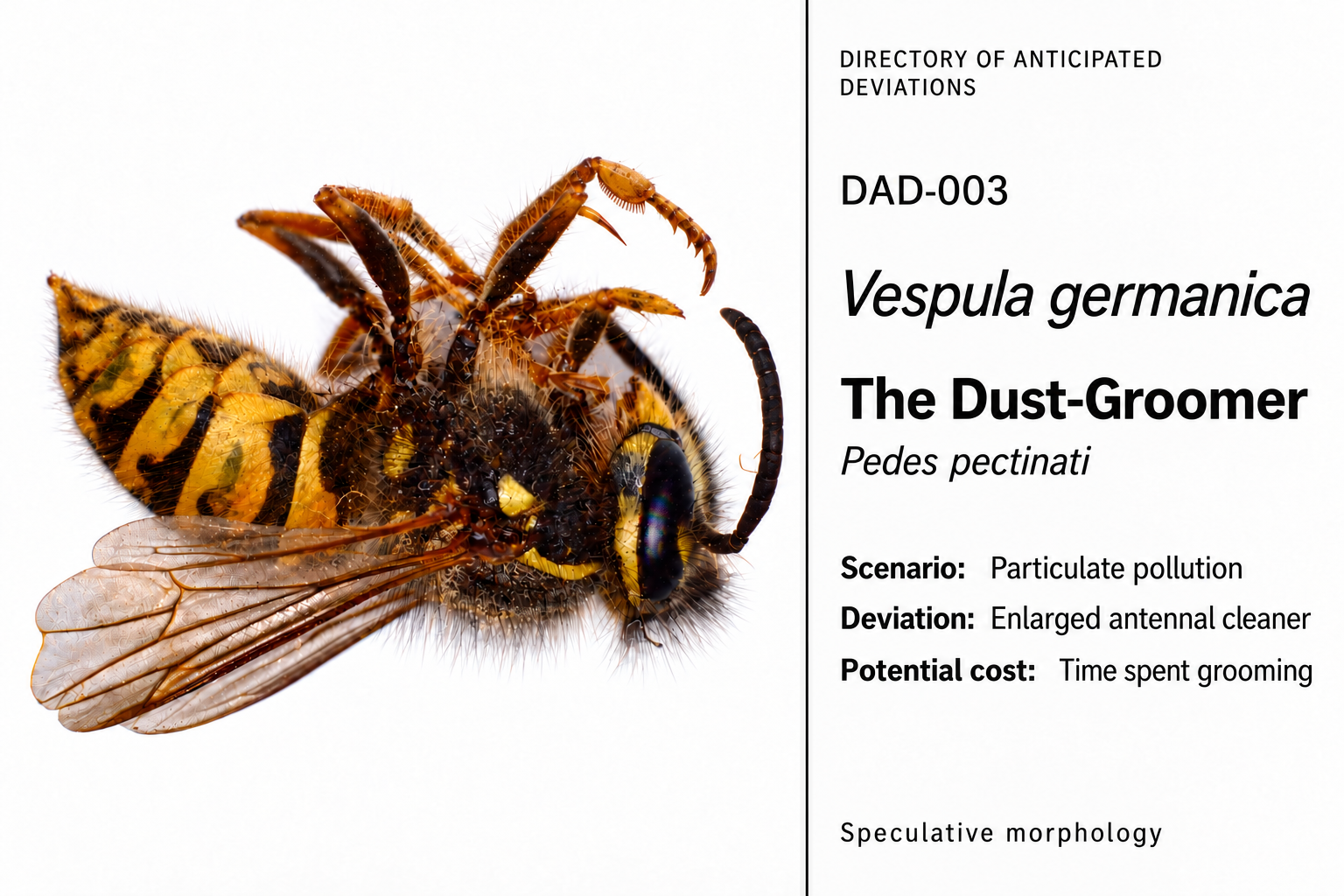
DAD-003
The Dust-Grooming
(Pedes pectinati)
Description
Constant exposure to soil dust, soot and airborne particles repeatedly coats the surfaces through which the wasp senses her surroundings. On the inner side of a forefoot, the Dust-Groomer carries an enlarged, curved cleaning notch lined with fine teeth and brushes. A spur at the end of the tibia closes against it, guiding an antenna through this small, precise apparatus. The two parts work together: holding, combing and clearing. The enlarged structure gives bodily form to an otherwise inconspicuous task. Again and again, the wasp must restore the surfaces through which food, nestmates and the route home become perceptible.
Scientific Context
In the ant Camponotus rufifemur, the bristles, comb, and brush on the front leg already function as a multi-stage particle filter: Different structures remove contaminants of varying sizes from the antennae.¹ Experiments on cockroaches show what happens without this grooming: Deposits cover the pores of the sensory hairs, and the antennae respond less sensitively to odors.² In houseflies, even brief exposure to airborne particles impaired their perception of food and mating odors.³ The Dust-Groomer takes this existing cleaning principle to the level of a physical specialization. Her enlarged apparatus could interfere with other uses of the foreleg; repeated cleaning also competes with the time available for foraging and brood care. The body can still keep its senses clear. The environment, which repeatedly challenges it, remains.
¹ A. Hackmann et al., ‘Functional morphology and efficiency of the antenna cleaner in Camponotus rufifemur ants’, Royal Society Open Science, 2 (2015), 150129. https://doi.org/10.1098/rsos.150129
² K. Böröczky et al., ‘Insects groom their antennae to enhance olfactory acuity’, Proceedings of the National Academy of Sciences (2013). https://pmc.ncbi.nlm.nih.gov/articles/PMC3587213/
³ ‘Short-term particulate matter contamination severely compromises insect antennal olfactory perception’, Nature Communications, 14 (2023), 4112. https://doi.org/10.1038/s41467-023-39469-3
DAD-004
Vibration Reader
(SENSILLA TARSALIA AUCTA)
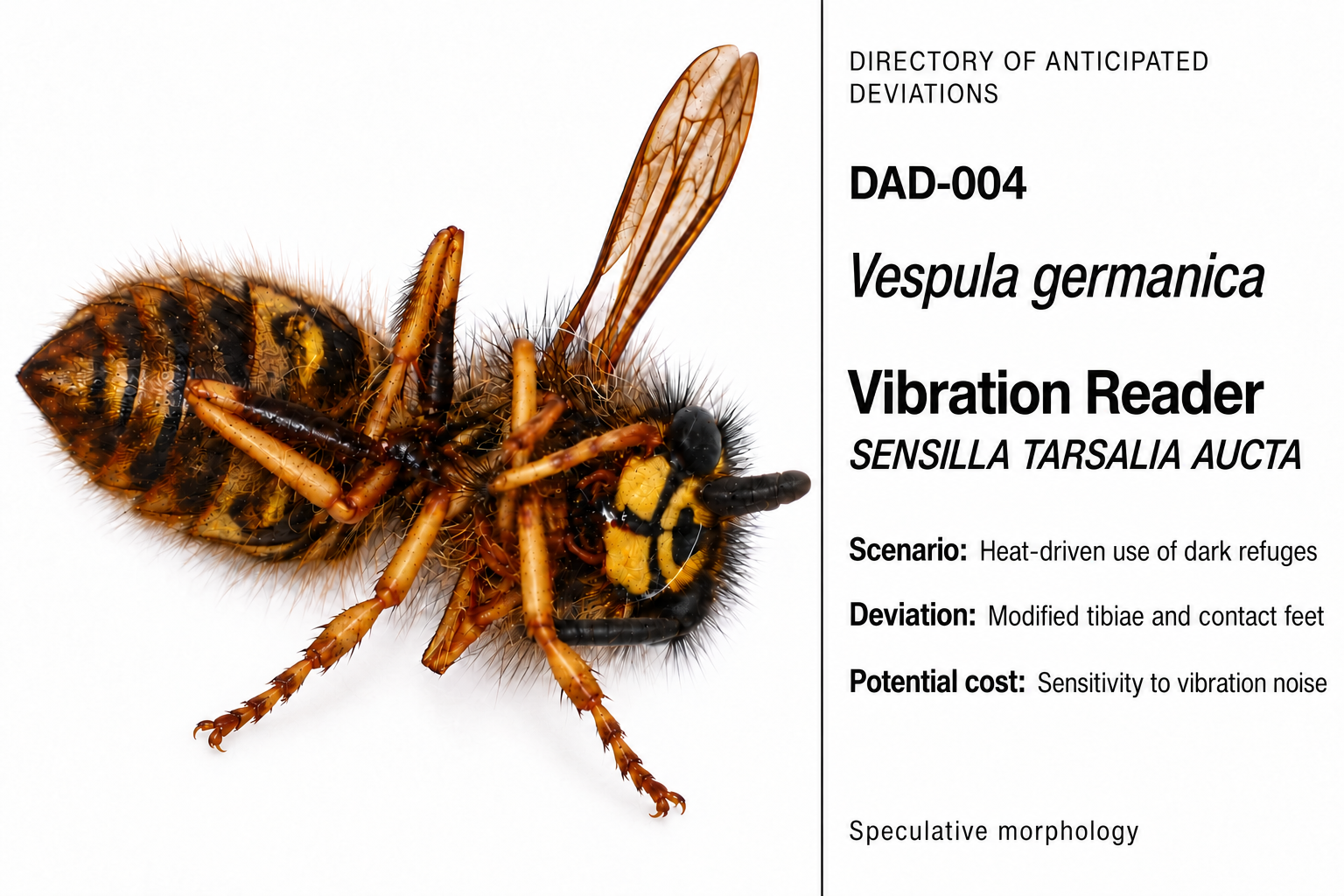
Description
Sustained daytime heat shifts activity towards twilight and into sheltered cavities. In these dark spaces, the Vibration Reader brings the world into contact with her legs. Broadened foot segments rest against wood, stems or the nest wall; the tibiae above them are visibly thickened. Within the design, enlarged internal subgenual organs register movements transmitted through these contact points. A touch on the nest shell, the steps of another worker, a disturbance behind a surface: matter becomes perceptible through motion. The visible changes surround a sensory apparatus that remains concealed inside the legs. The body listens through its points of contact.
Scientific Context
Some parasitoid wasps locate hidden hosts using substrate vibrations they generate themselves. Subgenual organs inside the tibiae are involved in this perception; these internal organs are anatomically distinct from external fields of sensory hairs.¹ Experiments with Pimpla turionellae also show that ambient temperature influences the activity and success of this mechanosensory search.² However, sensitive perception remains dependent on distinguishable signals: In the green stink bug Nezara viridula, experimentally generated interference vibrations impaired the detection and localization of mating signals—even outside their actual frequency range.³ For the Vibration Reader, any additional contact with the environment could thus also introduce a new source of interference. Traffic, machinery, and construction work would intrude upon her perception precisely where she seeks shelter. The nest would remain dark, but it would no longer be a place of peace.
¹ G. R. Broad and D. L. J. Quicke, “The adaptive significance of host location by vibrational sounding in parasitoid wasps,” Proceedings of the Royal Society B: Biological Sciences, 267, No. 1460 (2000), pp. 2403–2409. https://doi.org/10.1098/rspb.2000.1298
² J. Samietz, S. Kroder, D. Schneider, and S. Dorn, “Ambient temperature affects mechanosensory host location in a parasitic wasp,” Journal of Comparative Physiology A, 192 (2006), pp. 151–157. https://doi.org/10.1007/s00359-005-0057-6
³ R. Janža, N. Stritih-Peljhan, A. Škorjanc, J. Polajnar, and M. Virant-Doberlet, “Vibrational noise disrupts Nezara viridula communication, irrespective of spectral overlap,” Communications Biology, 7 (2024), Article 1533. https://doi.org/10.1038/s42003-024-07185-3