CHAPTER 2: ENduring Exposure
Hier fehlt eine Einführung
DAD-003 (06)
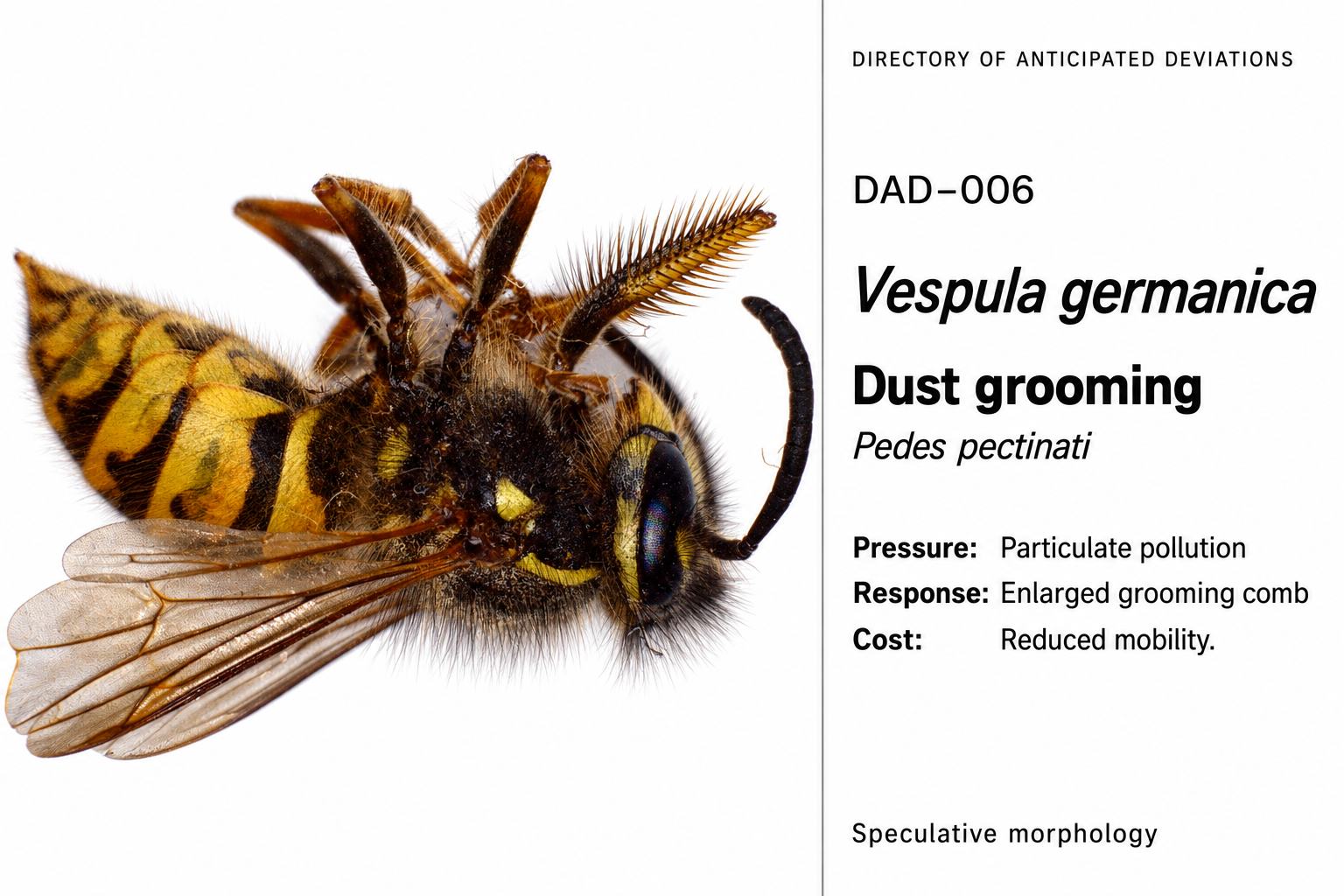
The Dust-Grooming
(Pedes pectinati)
Description
The dust-grooming carries a delicate cleaning tool on its front leg. An enlarged comb unfolds along its inner side: closely spaced teeth, sturdy bristles, and fine hairs form a tiered structure through which she pulls her antennae. The environmental pressure driving this evolution is constant exposure to stirred-up soil dust, soot, and abrasion. New particles are constantly depositing themselves on the sensitive sensory surfaces. In this evolved form of the German wasp, the unassuming cleaning device has developed into a striking bodily tool. With every stroke through the comb, she clears her sensory organs once again. The precision of this structure is astonishing: a single leg is responsible for maintaining the very senses the wasp uses to find food, fellow wasps, and her way through the world.
Scientific Context
In the ant Camponotus rufifemur, the bristles, comb, and brush on the front leg already function as a multi-stage particle filter: Different structures remove contaminants of varying sizes from the antennae.¹ Experiments on cockroaches show what happens without this grooming: Deposits cover the pores of the sensory hairs, and the antennae respond less sensitively to odors.² In houseflies, even brief exposure to airborne particles impaired their perception of food and mating odors.³ The dust-combing ant takes this existing cleaning principle to the level of a physical specialization. Its enlarged apparatus inherently limits the mobility of the front leg; the constant cleaning takes time that is otherwise needed for foraging and care. The body can still keep its senses clear. The environment, which repeatedly challenges it, remains.
¹ A. Hackmann et al., ‘Functional morphology and efficiency of the antenna cleaner in Camponotus rufifemur ants’, Royal Society Open Science, 2 (2015), 150129. https://doi.org/10.1098/rsos.150129
² K. Böröczky et al., ‘Insects groom their antennae to enhance olfactory acuity’, Proceedings of the National Academy of Sciences (2013). https://pmc.ncbi.nlm.nih.gov/articles/PMC3587213/
³ ‘Short-term particulate matter contamination severely compromises insect antennal olfactory perception’, Nature Communications, 14 (2023), 4112. https://doi.org/10.1038/s41467-023-39469-3
DAD-002
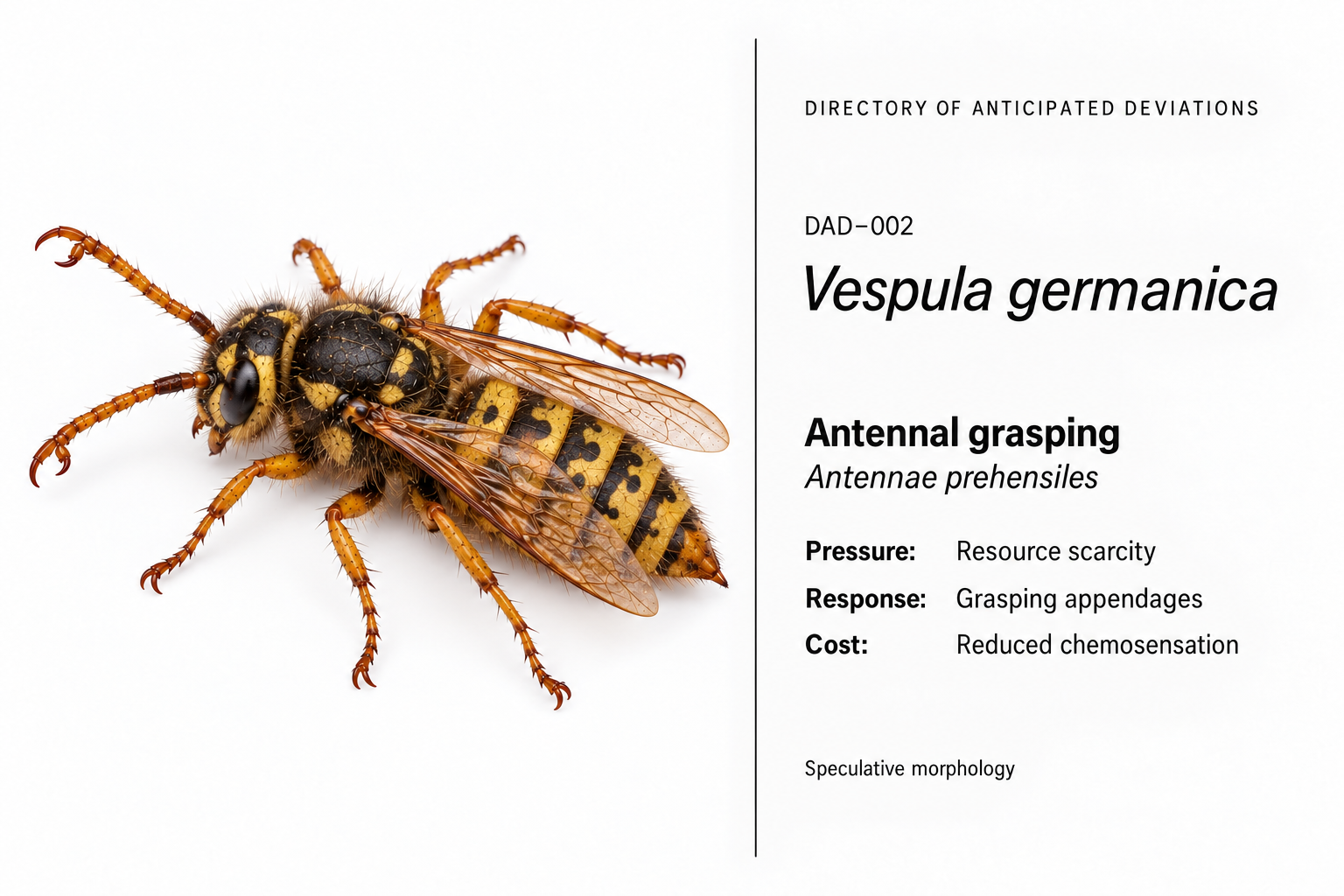
The Gripper
(Antennae prehensiles)
Description
Recurring droughts have made soft plant fibers and readily accessible food scarce. Usable material lies deep within cracks, beneath dry crusts, and between hardened layers. It is in this environment that the Gripper appears: its antennae have evolved into powerful, segmented tools. Unevenly curved terminal segments grasp, pry, and pull, while the six original legs support the body. The head gains its own working space. What once merely felt out the environment can now open it up. Within the developmental narrative described here, this new capacity for action provides access to resources that remain inaccessible to other bodies.
Scientific Context
The transformation of antennae into leg-like structures is one of the most striking findings in developmental genetics. In Drosophila, changes in the activity of the Hox gene Antennapedia can alter the identity of a body appendage. Studies show how closely antenna and leg development are linked and how crucial spatial and temporal gene regulation is.¹ ² ³ These studies provide no evidence for drought-induced grasping antennae or their utility in wasps. The proposal combines the proven malleability of the body plan with a hypothetical scenario of natural selection. The cost of this transformation is loss: where a tool emerges, a part of the original sensory organ disappears. The grasping tip achieves more—yet at the same time may perceive less of what it reaches.
¹ B. S. Emerald und S. M. Cohen, ‘Spatial and temporal regulation of the homeotic selector gene Antennapedia is required for the establishment of leg identity in Drosophila’, Developmental Biology (2004). https://pubmed.ncbi.nlm.nih.gov/15013806/
² M. Cummins et al., ‘Comparative analysis of leg and antenna development in wild-type and homeotic Drosophila melanogaster’, Development Genes and Evolution (2003). https://pubmed.ncbi.nlm.nih.gov/12768424/
³ F. Casares und R. S. Mann, ‘Control of antennal versus leg development in Drosophila’, Nature, 392 (1998), S. 723–726. https://www.nature.com/articles/33706
DAD-004 (03)
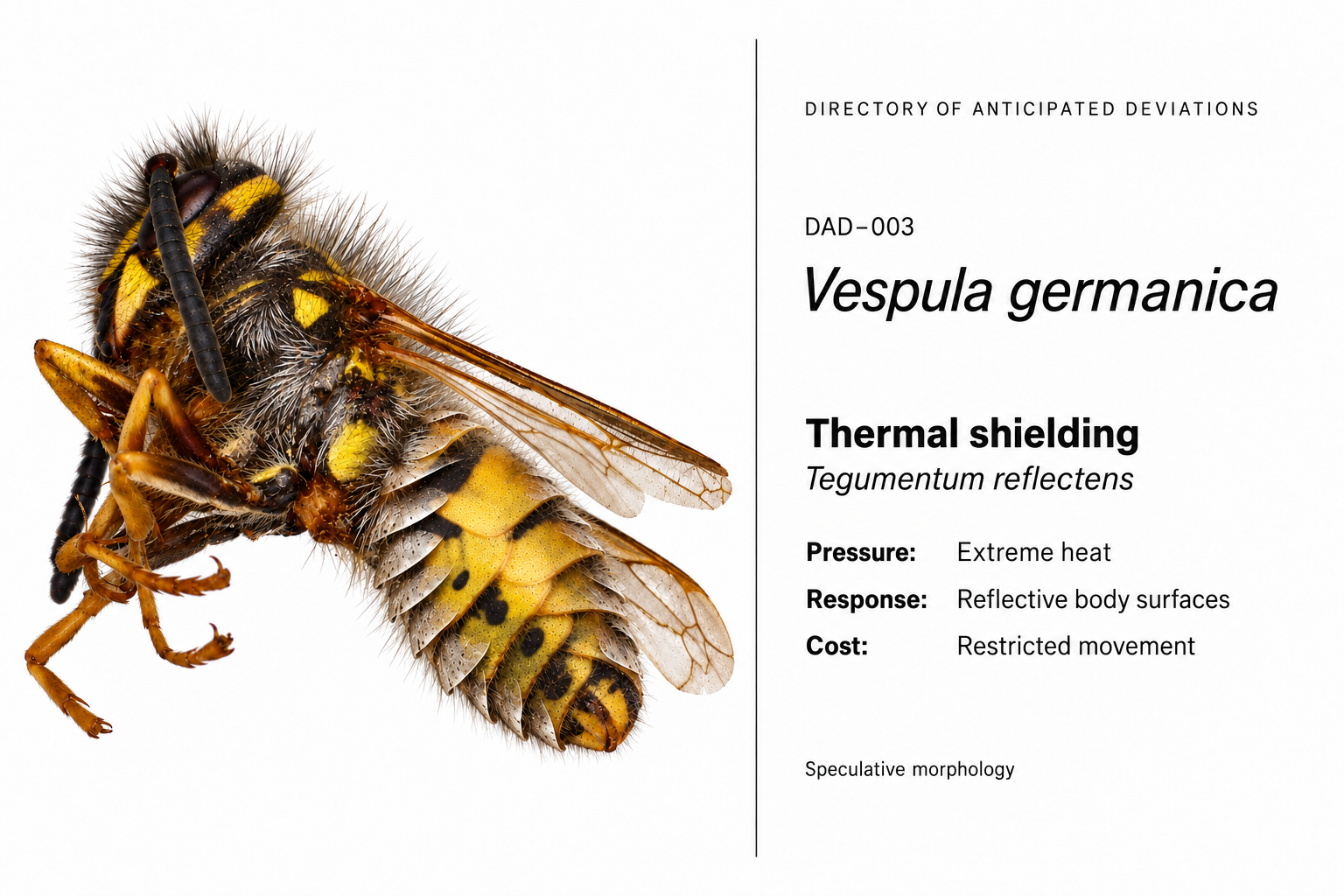
The Heat-Reflecting
(Tegumentum reflectens)
Description
The local average temperature has risen by three degrees in this scenario. Prolonged heat waves reduce the number of hours available for gathering food and tending to the nest. The Heat-Reflecting ant compensates for this lost time with a reflective body surface: silvery microhairs cover its thorax, and lateral lamellae fan out from the abdomen at varying angles. Light refracts off these fine structures and is reflected back. Under sustained heat stress, bodies with a more favorable radiation balance gain an advantage. The body surface becomes a finely structured instrument of heat exchange, enabling activity where other animals must already seek shelter.
Scientific Context
Saharan silver ants already possess this type of optical heat protection: Their specialized hairs reflect solar radiation and aid in heat dissipation.¹ ² A correlation between body color and climate is also evident in European butterflies and dragonflies: In warmer regions, lighter-colored species have an advantage.³ In Heat-Repelling, this correlation reaches its physical extreme. Their expansive lamellae both protect and hinder; nest openings become bottlenecks, and movement loses its freedom. While the body regains a few hours, its food supply continues to dry up. It endures longer in a world that can sustain it less and less.
¹ N. N. Shi et al., ‘Keeping cool: Enhanced optical reflection and radiative heat dissipation in Saharan silver ants’, Science (2015). https://pubmed.ncbi.nlm.nih.gov/26089358/
² Q. Willot et al., ‘Total Internal Reflection Accounts for the Bright Color of the Saharan Silver Ant’, PLOS ONE, 11 (2016), e0152325. https://doi.org/10.1371/journal.pone.0152325
³ D. Zeuss et al., ‘Global warming favours light-coloured insects in Europe’, Nature Communications, 5 (2014), 3874. https://doi.org/10.1038/ncomms4874
DAD-006 016 Die Gepanzerte
DAD-007 017 Die Entgiftende
DAD-008 19 Die Wartende
DAD-009 20 Die Keimabwehrende
DAD-005 (07)
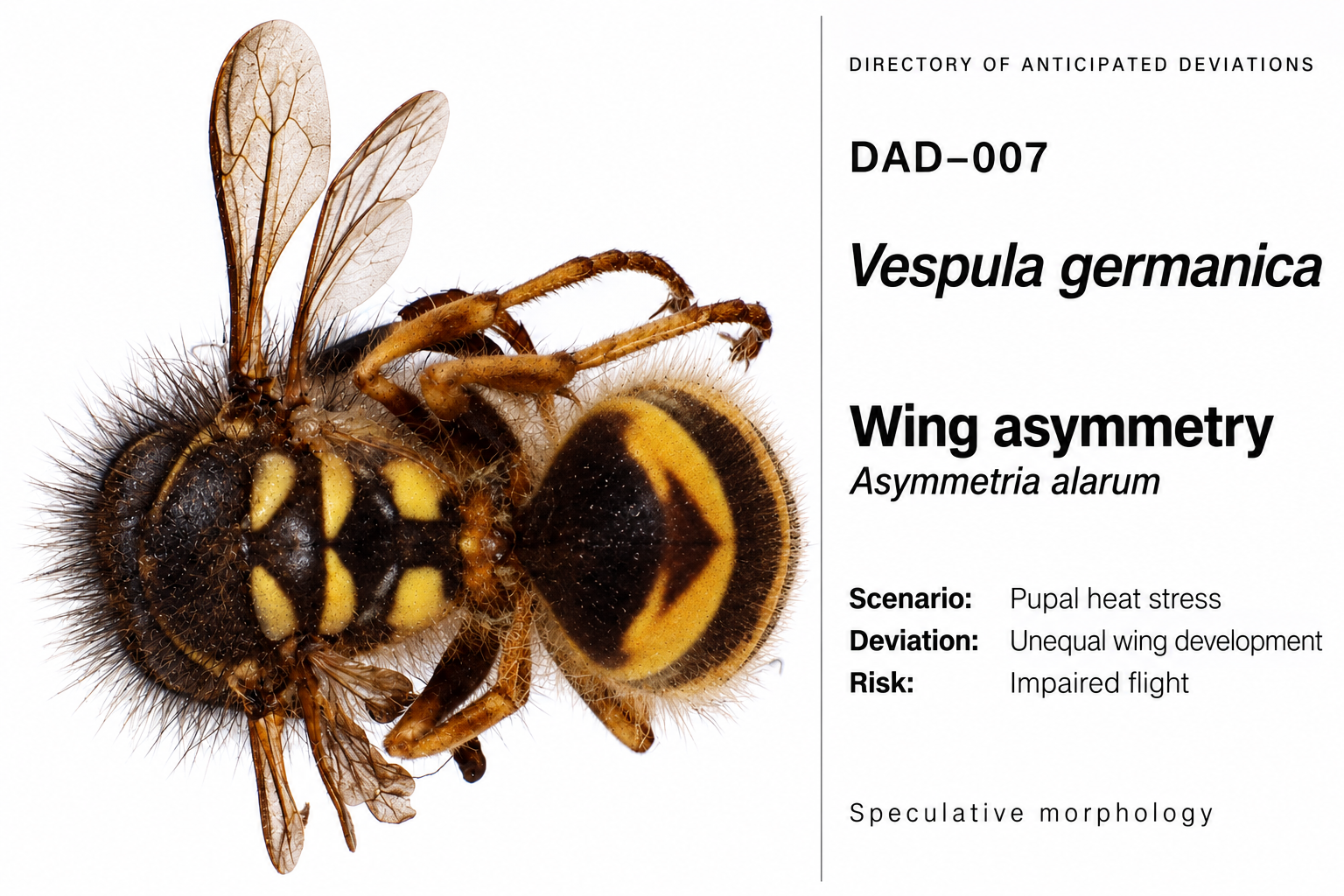
The Asymmetrical-Winged
(Asymmetria alarum)
Description
The Asymmetria alarum exhibits two distinct patterns of the same physical development. On one side, long, translucent wings unfold, their veins dividing the membrane into finely defined sections. On the opposite side, the wing surfaces remain shortened, curled, and folded in on themselves. The architecture of flight is still recognizable there, but the wings do not reach their fully extended form. The design assumes that the environmental stress involves recurring overheating during pupal development. This striking contrast highlights just how much coordination is required for the development of a body capable of flight. Here, a deviation arises whose potential consequences range from impaired maneuverability to the loss of flight capability.
Scientific Context
In the buff-tailed bumblebee (Bombus terrestris), experimental heat stress during pupal development led to more frequent wing deformities. Even in individuals without obvious malformations, wing shape and lateral symmetry were altered.¹ Recurring heat stress during pupation can also have effects beyond this developmental stage: Another study documented wing malformations and a reduced lifespan in adult bumblebees.² In fruit flies, the occurrence of abnormal wings following heat shocks depended on the intensity, duration, and timing of the stress.³ The vulnerable phase thus occurs
¹ S. Laußer und C. Kurze, ‘Impact of thermal stress during pupal development in a key pollinator’, Proceedings of the Royal Society B, 292 (2025), 20252029. https://doi.org/10.1098/rspb.2025.2029
² M. M. Mandlinger und C. Kurze, ‘Cyclic thermal stress during pupation triggers irreversible carry-over effects in a key pollinator’, Communications Biology (2026). https://doi.org/10.1038/s42003-026-10940-3
³ K. D. Williams et al., ‘Effect of heat shock, pretreatment and hsp70 copy number on wing development in Drosophila melanogaster’ (2003). https://pubmed.ncbi.nlm.nih.gov/12694280/