CHAPTER 4: Holding Together
Hier fehlt eine Einführung
DAD-018 (09)
The Stilt-Walker
(Pedes elongati)
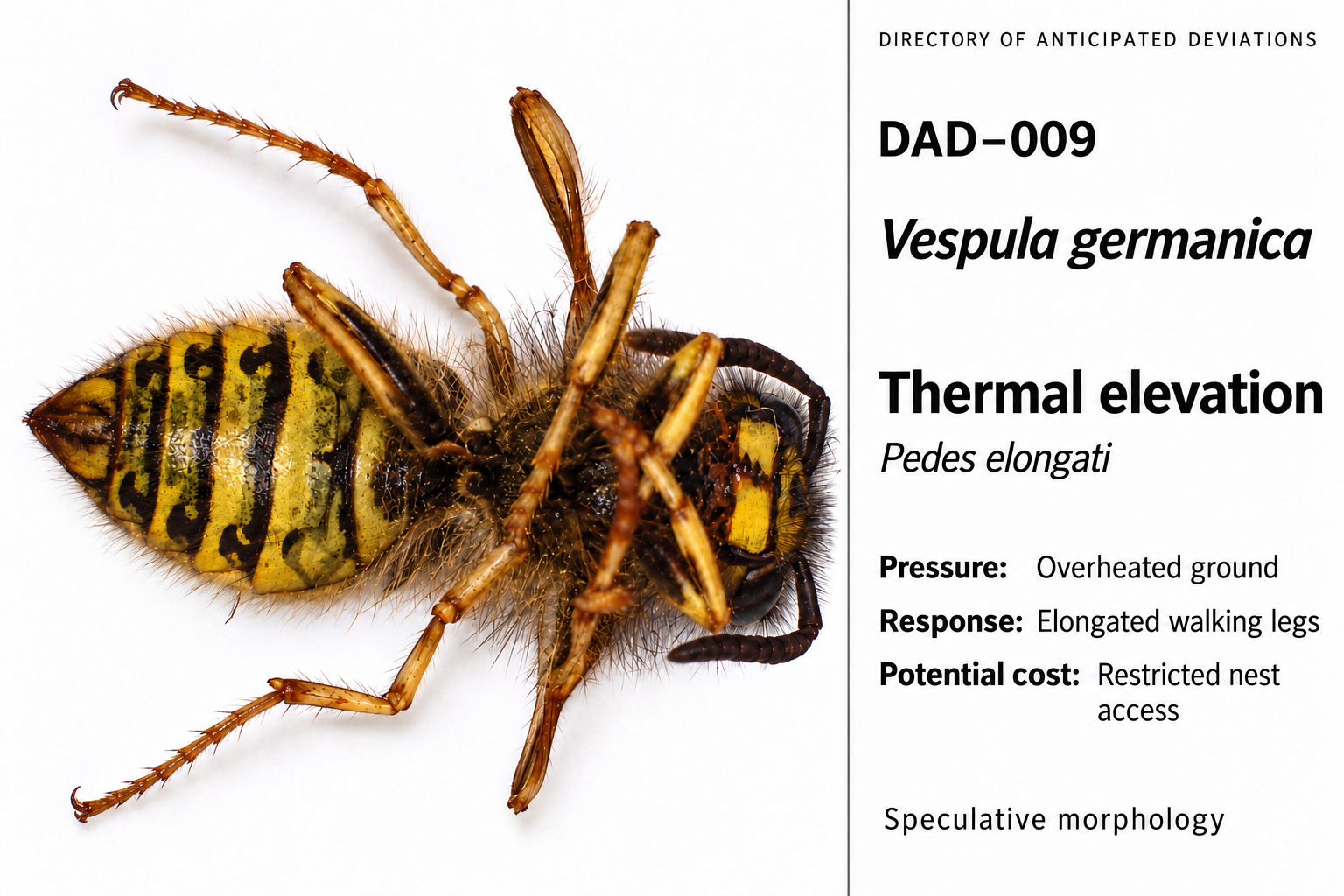
Description
The legs of the Stilt-Walker extend far beyond the familiar outline of its body. Elongated limbs form narrow, jointed arches; the small claws remain intact at their ends. When the body is at rest, these struts lie side by side, folded unevenly and stretched out. Their potential benefit becomes apparent when walking: a carefully coordinated leg posture lifts the thorax and abdomen further off the ground. Highly heated, unshaded ground surfaces provide the environmental pressure that shapes this form. An additional gap is created between the body and the surface, which can already provide access to a different thermal environment near the ground. The wasp carries the possibility of a small refuge within the length of its limbs.
Scientific Context
Heat-loving desert ants of the genera Cataglyphis and Ocymyrmex have particularly long legs that can lift their bodies into cooler layers of air above the hot ground.¹ Studies of their locomotion also show how closely leg length, stride sequence, and ground contact interact; particularly high speeds can be achieved even with comparatively shorter legs and higher stride frequencies.² ³ In the case of the “stilt-walker,” this elongation also alters the relationship to its own nest. When passing through narrow passages, turning between the honeycombs, and working on the cell edges, the legs must be tucked in and repositioned. If larger distances between honeycombs and wider entrances become necessary, the colony’s space requirements increase. If the nest architecture remains unchanged, certain construction and maintenance tasks could increasingly fall to the shorter-legged workers. The long-legged worker gains distance from the hot ground but at the same time risks losing access to parts of her own nest.
¹ S. Sommer und R. Wehner, ‘Leg allometry in ants: Extreme long-leggedness in thermophilic species’, Arthropod Structure & Development (2012). https://pubmed.ncbi.nlm.nih.gov/21992805/
² ‘Walking and running in the desert ant Cataglyphis fortis’, Journal of Comparative Physiology A (2015). https://doi.org/10.1007/s00359-015-0999-2
³ ‘High-speed locomotion in the Saharan silver ant, Cataglyphis bombycina’, Journal of Experimental Biology, 222 (2019), jeb198705. https://pubmed.ncbi.nlm.nih.gov/31619540/
DAD-019 (14)
Vibration Reader
(SENSILLA TARSALIA AUCTA)
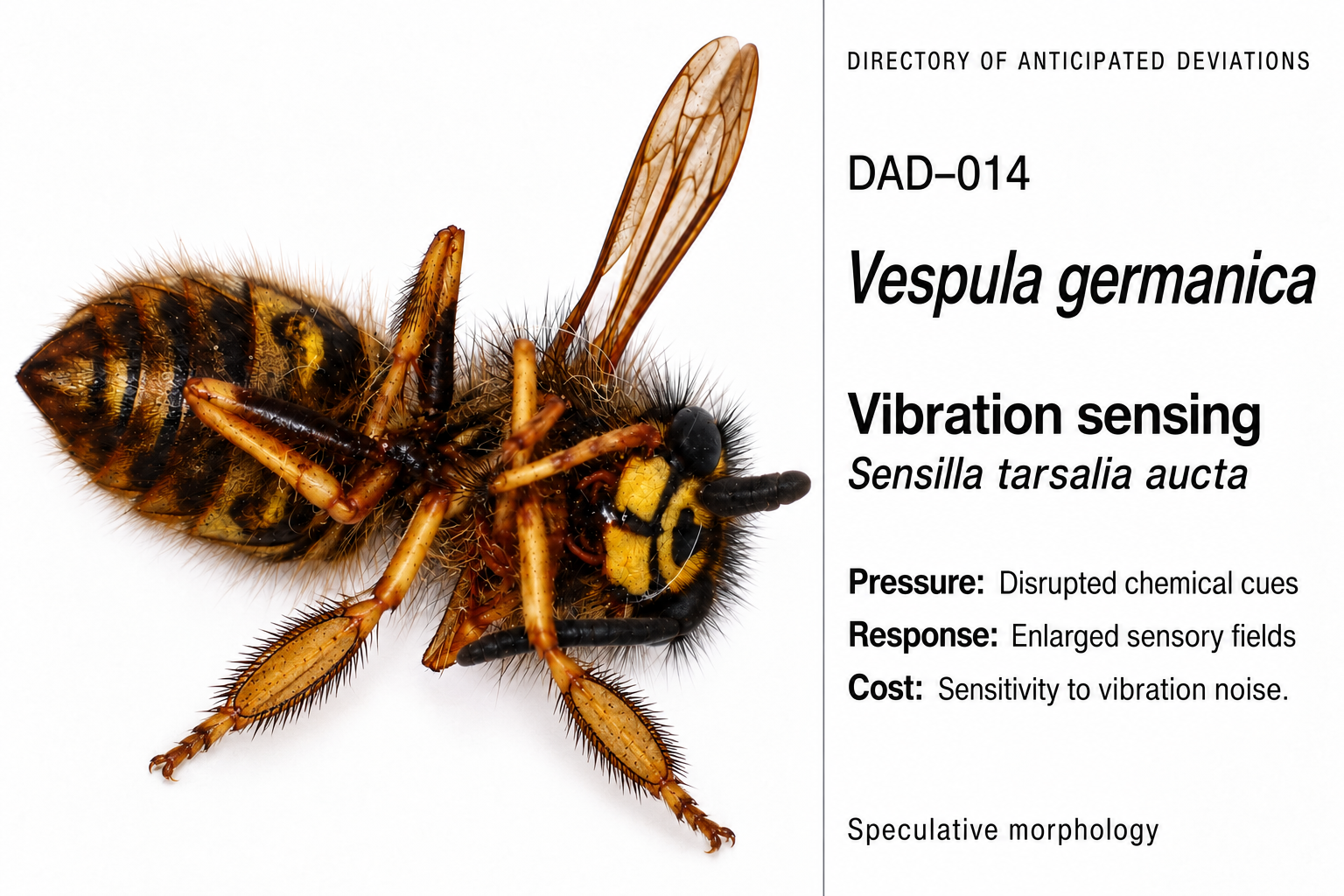
Description
The legs become instruments of perception that function without light. Widened foot segments establish contact with the ground; enlarged mechanosensory organs are embedded in the reinforced rails. The Vibration Reader pauses, spreads its legs across the surface, and detects the faintest vibrations traveling through wood, plant stems, or nest walls. The environmental pressure in this design is sustained daytime heat, which shifts activity into twilight and into sheltered, dark cavities. Where visual orientation reaches its limits, the movement of the material takes on greater significance. A hidden rustling, a touch on the nest shell, the footsteps of another worker: the ground becomes a conduit for messages. The world extends beyond what is visible.
Scientific Context
Some parasitoid wasps locate hidden hosts using substrate vibrations they generate themselves. Subgenual organs inside the tibiae are involved in this perception; conspicuous external hair fields alone do not explain this ability.¹ Experiments with Pimpla turionellae also show that ambient temperature influences the activity and success of this mechanosensory search. ² However, sensitive perception remains dependent on distinguishable signals: In the green stink bug Nezara viridula, experimentally generated interference vibrations impaired the detection and localization of mating signals—even outside their actual frequency range.³ For the vibration-detecting insect, any additional contact with the environment could thus also introduce a new source of interference. Traffic, machinery, and construction work would intrude upon her perception precisely where she seeks shelter. The nest would remain dark, but it would no longer be a place of peace.
¹ G. R. Broad and D. L. J. Quicke, “The adaptive significance of host location by vibrational sounding in parasitoid wasps,” Proceedings of the Royal Society B: Biological Sciences, 267, No. 1460 (2000), pp. 2403–2409. https://doi.org/10.1098/rspb.2000.1298
² J. Samietz, S. Kroder, D. Schneider, and S. Dorn, “Ambient temperature affects mechanosensory host location in a parasitic wasp,” Journal of Comparative Physiology A, 192 (2006), pp. 151–157. https://doi.org/10.1007/s00359-005-0057-6
³ R. Janža, N. Stritih-Peljhan, A. Škorjanc, J. Polajnar, and M. Virant-Doberlet, “Vibrational noise disrupts Nezara viridula communication, irrespective of spectral overlap,” Communications Biology, 7 (2024), Article 1533. https://doi.org/10.1038/s42003-024-07185-3
DAD-020 (15)
The Rasping One
(Apparatus stridulatorius)
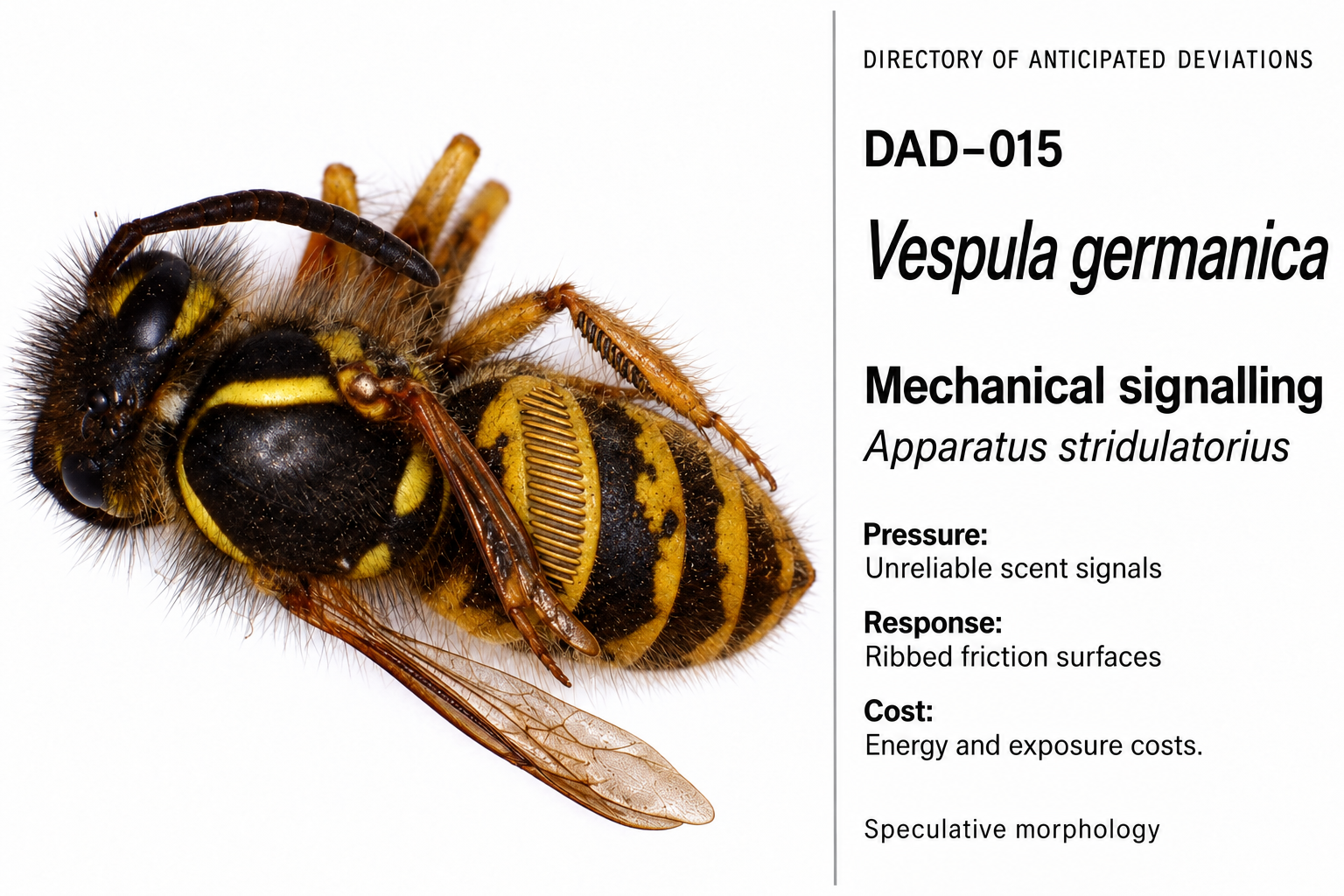
Description
A finely ribbed surface forms at the junction of two abdominal segments. A hardened edge of the adjacent segment strokes across it as soon as the abdomen moves: the body becomes an instrument. Short, rhythmic impulses are transmitted through the outstretched legs into the nest structure. The environmental pressure driving this design is the increasing daytime heat, which prolongs stays in the sheltered nest and intensifies the shared use of limited retreat spaces. Amid densely packed bodies and winding honeycombs, the “Rasping One” supplements chemical and tactile communication with mechanical signals. She can attract attention without directly touching another worker. The paper walls become a medium of transmission; a small movement generates a message that extends beyond her own body.
Scientific Context
In leafcutter ants, substrate vibrations generated by stridulation serve to recruit nestmates in the immediate vicinity.¹ In Myrmica ants, auditory signals can also convey social status: the sounds produced by queens trigger special attention from workers—an effect that certain butterfly larvae and pupae exploit by mimicking these sounds. ² At the same time, experiments with Nezara viridula show how disruptive vibrations can impair the detection and localization of social signals.³ For leaf-cutting ants, this creates a delicate balance between communication and interference. What allows a single worker to be heard could cause signals to overlap when many ants are transmitting simultaneously. Traffic and machinery would introduce additional vibrations. The colony could generate more and more messages yet be able to reliably distinguish fewer and fewer of them.
¹ F. Roces and B. Hölldobler, “Use of stridulation in foraging leaf-cutting ants: Mechanical support during cutting or short-range recruitment signal?”, Behavioral Ecology and Sociobiology, 39, No. 5 (1996), pp. 293–299. https://doi.org/10.1007/s002650050292
² F. Barbero, J. A. Thomas, S. Bonelli, E. Balletto, and K. Schönrogge, “Queen ants make distinctive sounds that are mimicked by a butterfly social parasite,” Science, 323, No. 5915 (2009), pp. 782–785. https://doi.org/10.1126/science.1163583
³ R. Janža, N. Stritih-Peljhan, A. Škorjanc, J. Polajnar, and M. Virant-Doberlet, “Vibrational noise disrupts Nezara viridula communication, irrespective of spectral overlap,” Communications Biology, 7 (2024), Article 1533. https://doi.org/10.1038/s42003-024-07185-3