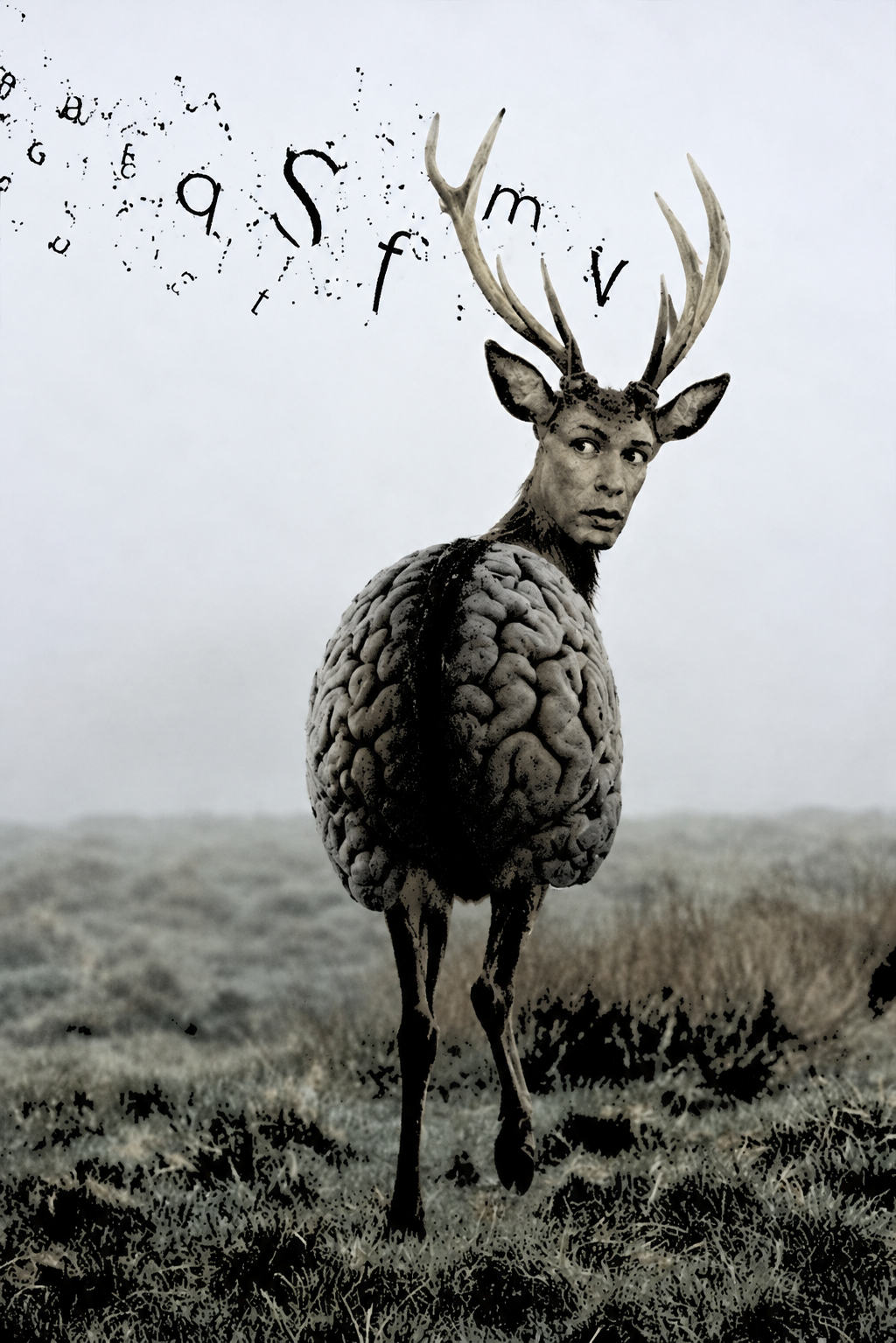
THE BRAIN DEER
A field guide to a species with very little privacy | 2017
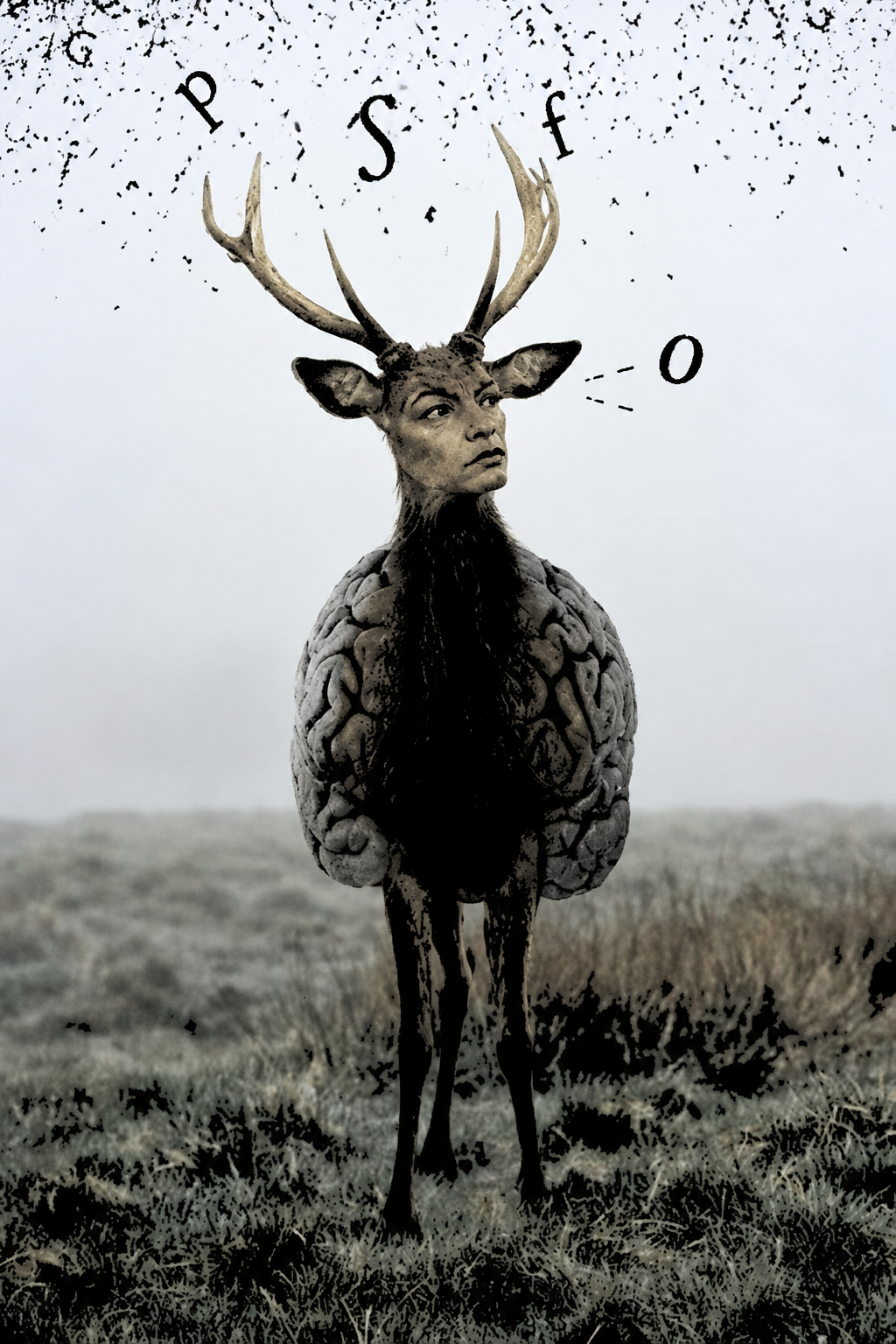
Provisional scientific name:
Cerebrocervus apertus
Distinguishing feature:
Thoughts visible above the head
General appearance
The Brain Deer combines a deer’s legs, ears and antlers with a human face and a torso largely composed of exposed cerebral folds. Thinking occupies most of its body.
Its slender legs carry this considerable mental apparatus with surprising composure. From a distance, the animal may appear entirely at ease. Closer observation of the activity above its antlers often suggests otherwise.
Thought and speech
The antlers make thoughts visible.
Letters emerge between their branches, briefly assembling into words before drifting apart. Some thoughts become fully legible. Others leave the head as fragments, revisions or isolated punctuation. A particularly persistent thought may remain caught on an antler long after the animal has attempted to move on.
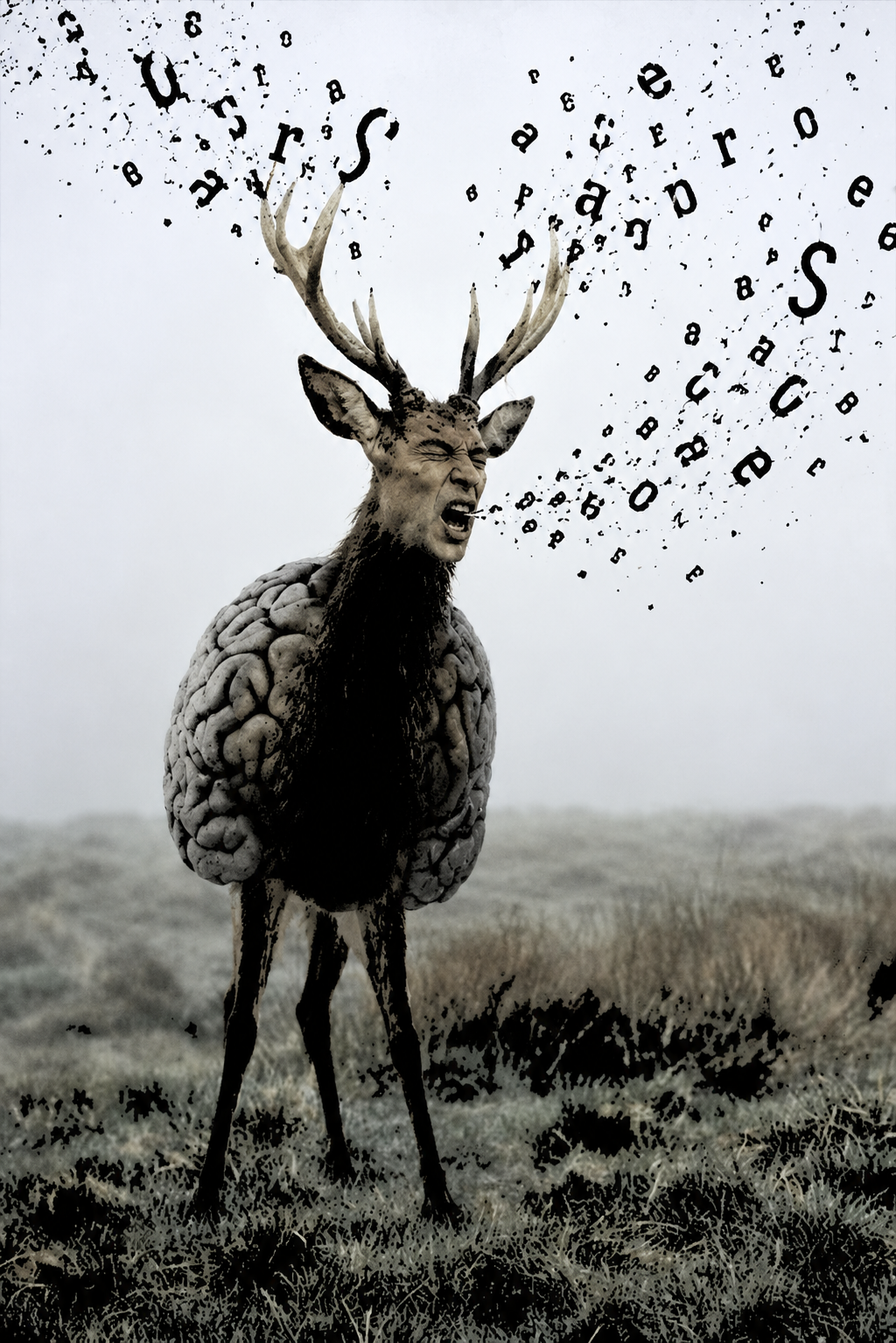
Spoken language still comes from the mouth. It requires the Brain Deer to choose what it wishes to say.
This produces two simultaneous channels of communication: what is being considered above the head, and what is being offered to someone else.
Their correspondence is variable.
Habitat
Brain Deers inhabit open landscapes with sufficient space above the head for unfinished sentences.
They are often found at the edges of woods, on quiet coastlines and just outside conversations they are still thinking about joining. Dense vegetation presents a practical difficulty: longer trains of thought become entangled in low branches.
A clear horizon is preferred, although it does not necessarily lead to a clear conclusion.
Feeding habits
The species grazes on vegetation and gathers impressions with considerably less discrimination.
A passing remark, a change in the weather or an unfamiliar word may occupy the animal for several hours. Nutritional value appears to have little influence on what is retained.
Field researchers have repeatedly observed specimens neglecting perfectly adequate food while examining a minor ambiguity.
Social behaviour
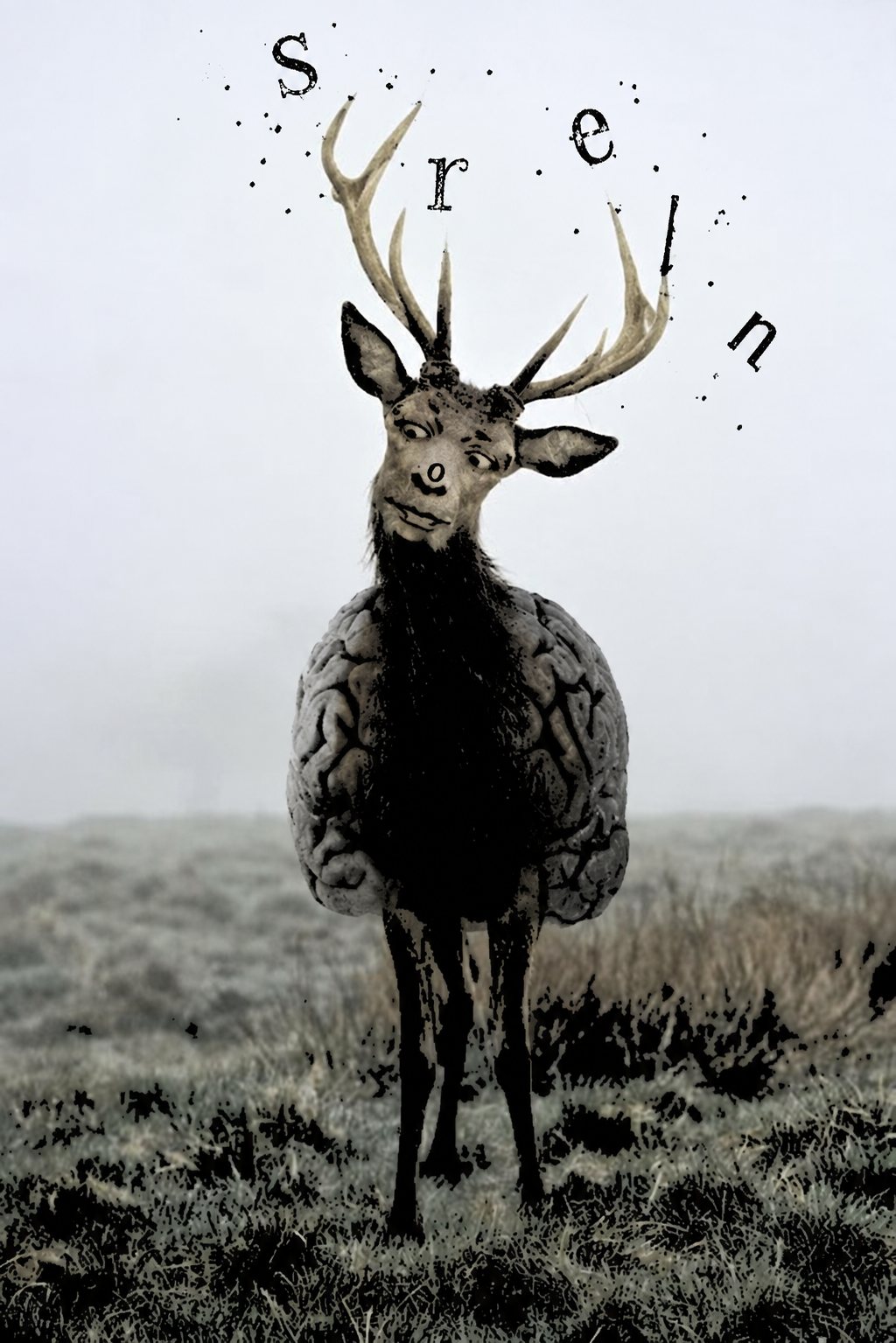
Brain Deers approach one another cautiously. At close range, each can read portions of the other’s thought activity.
This would appear to simplify social life.
It does not.
An emerging word may be read before the rest of the sentence arrives. A question may be mistaken for a conviction. A fleeting possibility may receive a response before its author has decided whether to pursue it.
During an encounter, one Brain Deer may therefore answer a thought while the other continues a spoken conversation about something entirely different. Both leave with the impression that the exchange was unusual.
Courtship and proximity
In the presence of a favoured companion, thought production often increases while speech becomes noticeably less informative.
One specimen may say, “Nice weather,” beneath an elaborate and rapidly expanding arrangement of letters.
The other may politely look at the sky.
Standing side by side appears to be a particularly successful form of companionship. It allows the animals to share a view without continuously reading one another.
Defensive behaviour
When startled, a Brain Deer becomes still. This reduces bodily movement but does little to conceal the word RUN forming above its head.
Attempts to suppress a thought frequently make it more prominent. The instruction DO NOT THINK ABOUT THIS has been recorded on several occasions and is considered an unreliable camouflage strategy.
The most effective defence is distance. Beyond a certain point, even an urgent thought becomes too small to read.
Exceptional abilities
The species is unusually good at making uncertainty visible. Its antlers can hold several possibilities at once without immediately resolving them.
Among patient companions, misunderstandings can sometimes be corrected before they become established. A troubling word may be followed by a qualification, an apology or the remainder of the sentence.
Given enough time, the antlers occasionally explain themselves.
Evolutionary disadvantages
The Brain Deer cannot easily enjoy the privacy of a first draft.
It may be held accountable for thoughts it was only passing through. An abandoned opinion can remain visible after its replacement has already formed. Silence offers limited protection.
Its exposed cerebral body also requires care. Despite the impressive antlers, the animal is poorly equipped for prolonged contact with sharp objects or categorical statements.
A note on observation
Visible thoughts should be approached with the same care as any living process.
They are incomplete, responsive to their surroundings and liable to change while being observed. Looking closely does not guarantee understanding. Reading faster does not help.
The Department of Imaginary Affairs recommends allowing a Brain Deer to finish speaking, even when something more interesting appears to be happening above its head.
Field note:
The most considerate companion is not always the one who reads everything.