THE GREAT FIASCO
A Thought Experiment Using AI AnD Adobe photoshop
2026
The Great Fiasco explores failure: the distance between intention and outcome, the limits of human control, and the point at which apparent success becomes catastrophe. It examines endeavours that undermine their own purpose and systems that continue to function while destroying the conditions on which their existence depends.
Within the Department of Imaginary Affairs, speculative worlds and short visual narratives emerge between humour, absurdity and unease. Bodies, landscapes and imagined apparatuses reveal the consequences of desires, rules and interventions. Protection can become isolation, care can become control, and improvement can lead to the loss of what was meant to be preserved.
The project unfolds in sections, each approaching failure inspired from a different artistic perspective. Each section opens a distinct line of inquiry within this shared theme. As an ongoing project, The Great Fiasco remains open to new visual languages, questions and forms.
THE GREAT FIASCO — Bosch Reimagined
The series begins with a thought experiment: How might an artist like Hieronymus Bosch (1450/55–1516) have approached failure if he had had access to digital image editing and generative AI? This question becomes the starting point for a visual world of my own, where hybrid beings, organic architectures and grotesque transformations meet the promises of the twenty-first century.
AI is both a tool and a subject of reflection. It enables a speculative encounter with Bosch and with a present in which security, optimisation, attention and control are increasingly organised through technological systems. Individual monitors appear at pivotal points within the organic scenes: they prescribe an ideal form, recommend the next improvement or confirm a success whose consequences unfold elsewhere in the image.
Across eight tableaux, initially understandable desires acquire a destructive momentum. Protection seals off the last access to the environment; care deprives its recipient of the ability to act; the fulfilment of wishes leaves those who receive them unable to move. The fiasco arises from the continued application of a flawed solution that has not been thought through.
The Three Hybrid Beings
The Great Fiasco unfolds in an imagined world inhabited by three recurring hybrid species. The project does not focus on just three individual beings: multiple members of each species may appear throughout the images. Each species has a recurring social function, but none is inherently good or evil. Together, they set processes in motion, carry them forward and keep them going—even when their efforts have unintended consequences.
The beings draw on the visual world of Hieronymus Bosch. His paintings are populated by impossible creatures that seem entirely at home: animal bodies take on human postures, familiar objects become part of unfamiliar bodies, and the grotesque appears as a natural element of an inhabited world. This visual logic is the starting point for the hybrid species in the project.
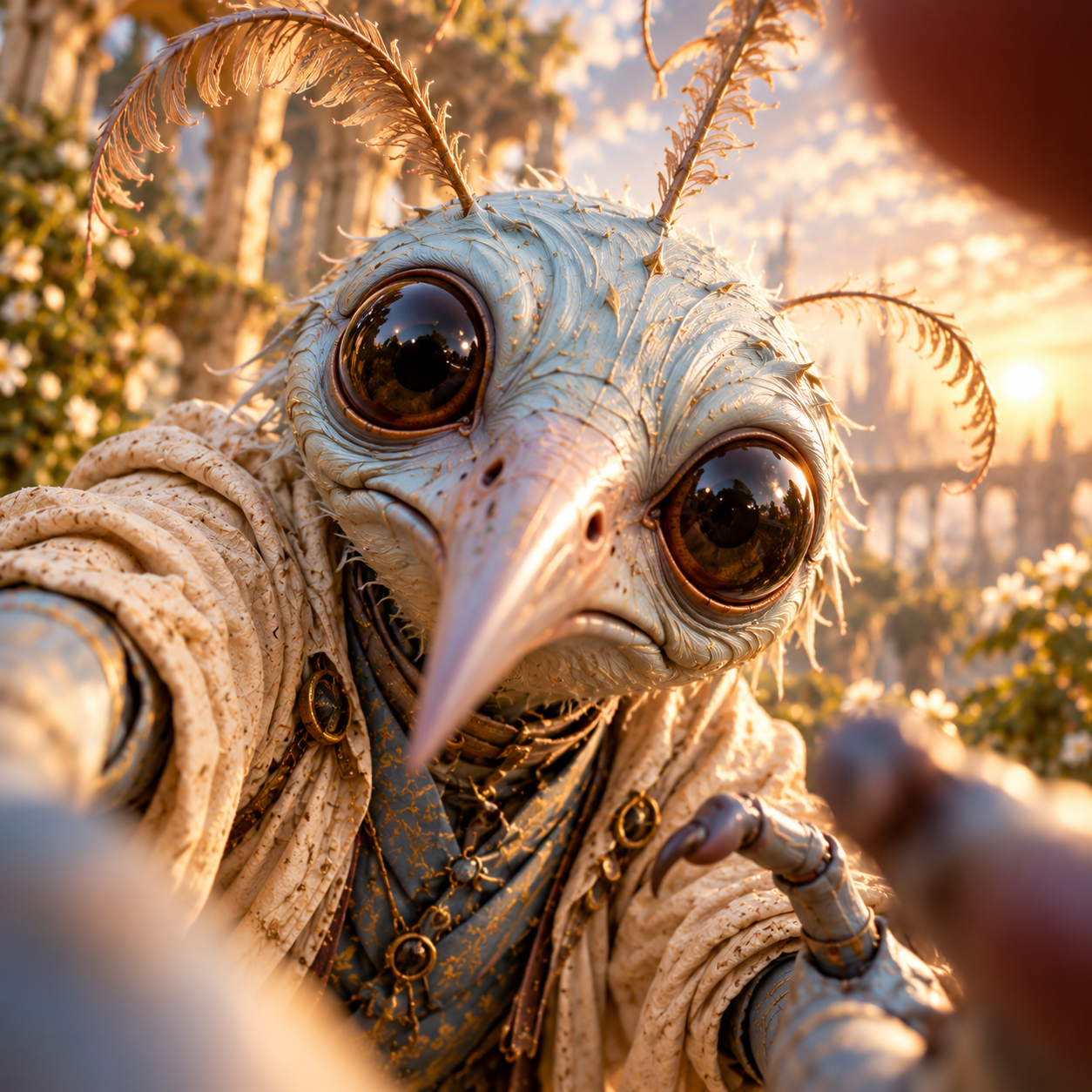
The Problem Solvers are blue hybrid beings with feathered heads, large eyes and several arms. Their light clothing and gestures combine animal features with the capacity for human action. They intervene in processes, repair, organise and put solutions into practice. They are not evil or indifferent: they are attentive and well-meaning, yet increasingly strained and overwhelmed by problems that demand ever more solutions.
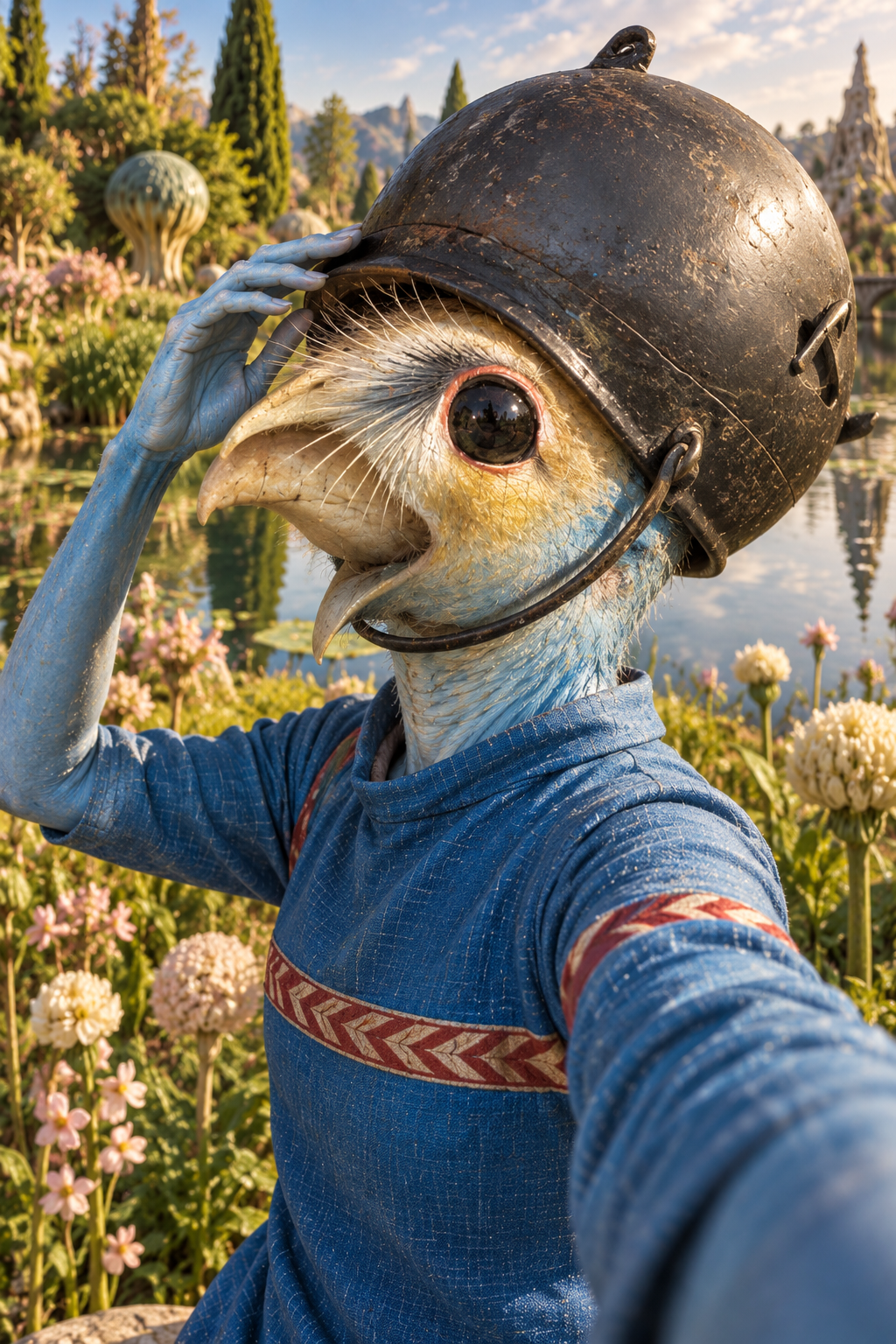
The Pot Birds, recognisable by their iron pot helmets and blue garments, gather and preserve what society produces—even when care or order has already turned into excess and harm.
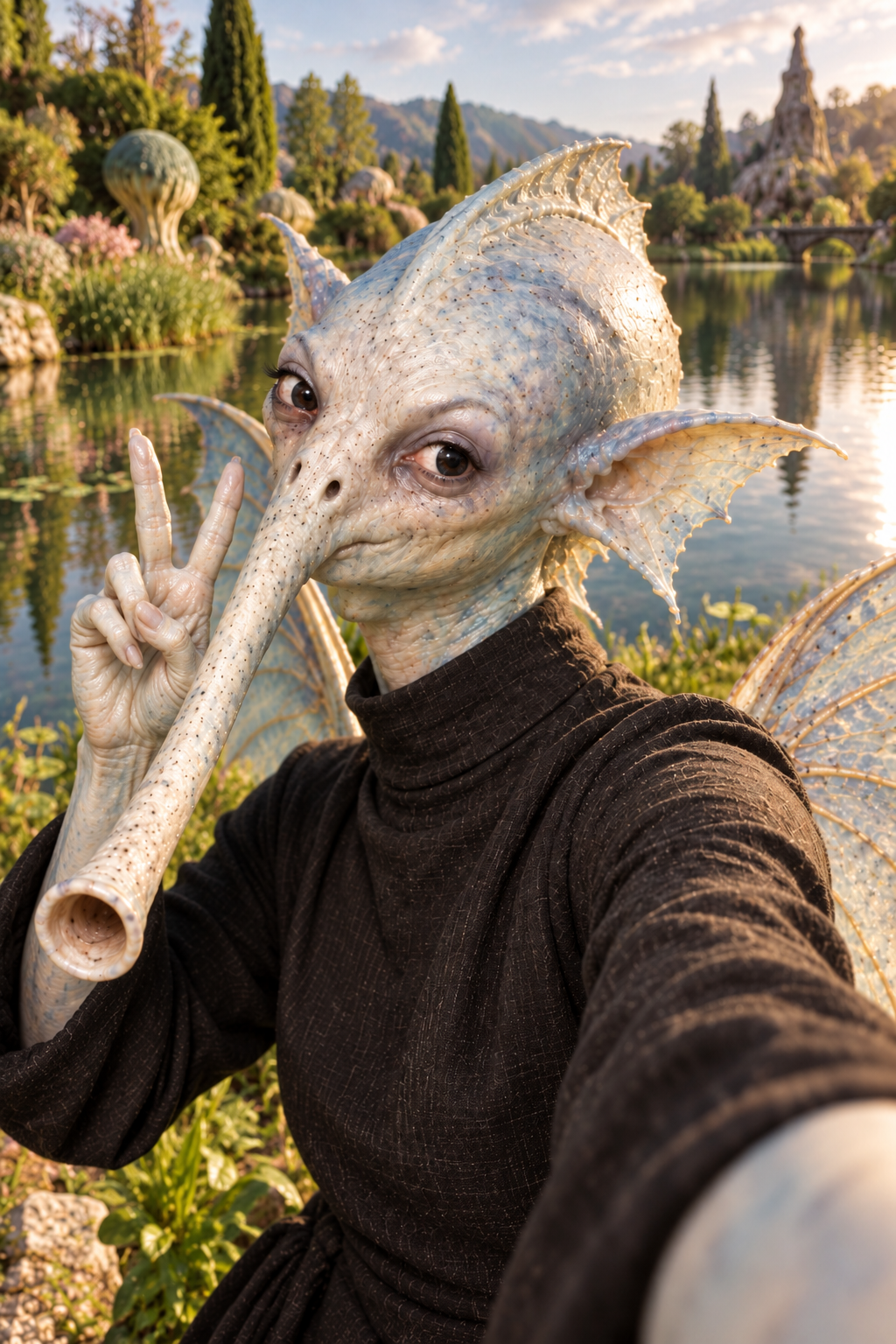
The Trumpet Creatures, with their long, trumpet-shaped beaks, announce promises, rules and appeals. They give voice to the world’s ideas and expectations, setting the signals that the other species follow.
Together, the three species make the mechanics of the fiasco visible: the Trumpet Creatures announce, the Pot Birds gather and preserve, and the Problem Solvers put things into practice. Their roles remain constant throughout the project, while the consequences of their actions change from chapter to chapter. In this way, the project’s human themes unfold through gestures, relationships and processes, without human characters at the centre.
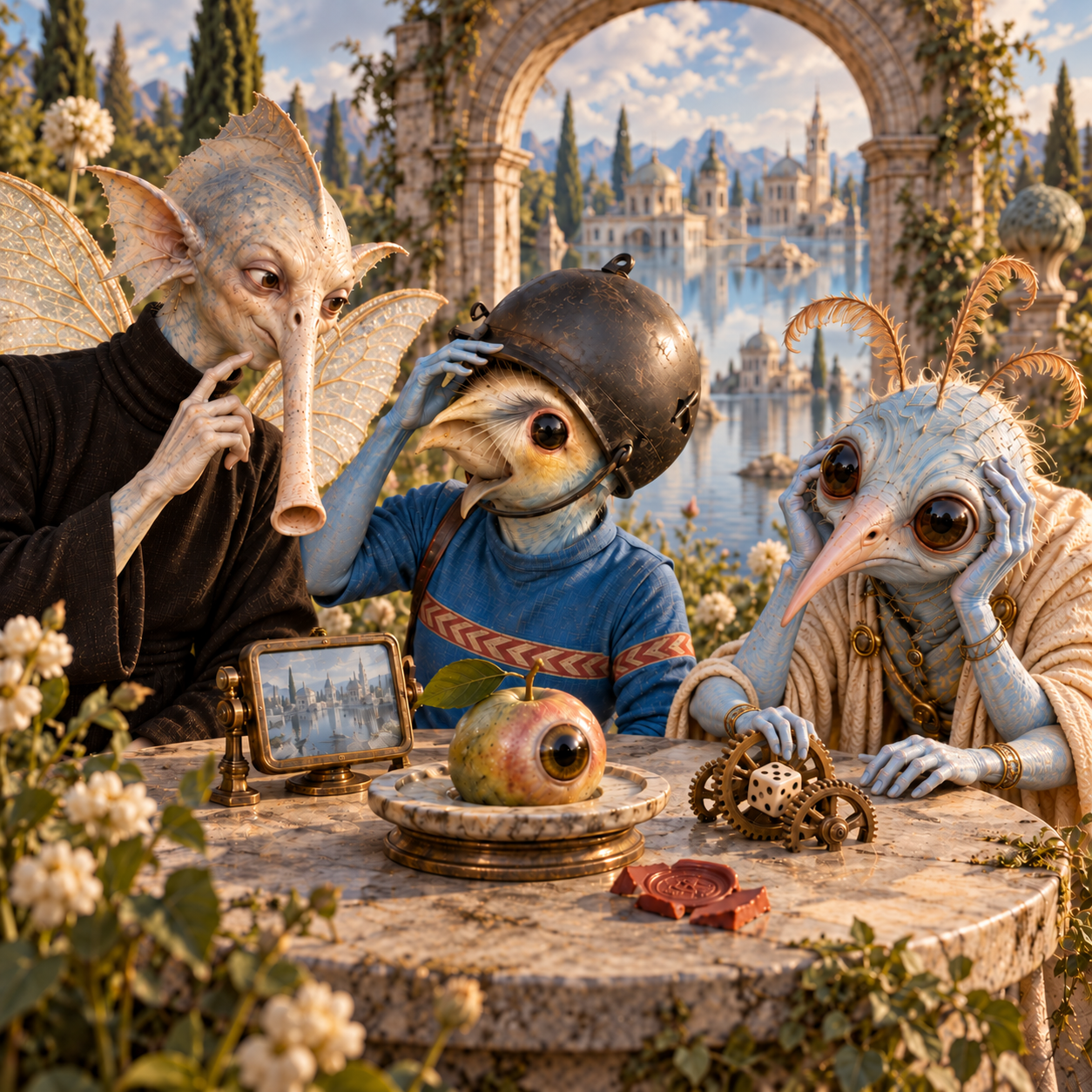
Chapter I — The Harvest of Attention
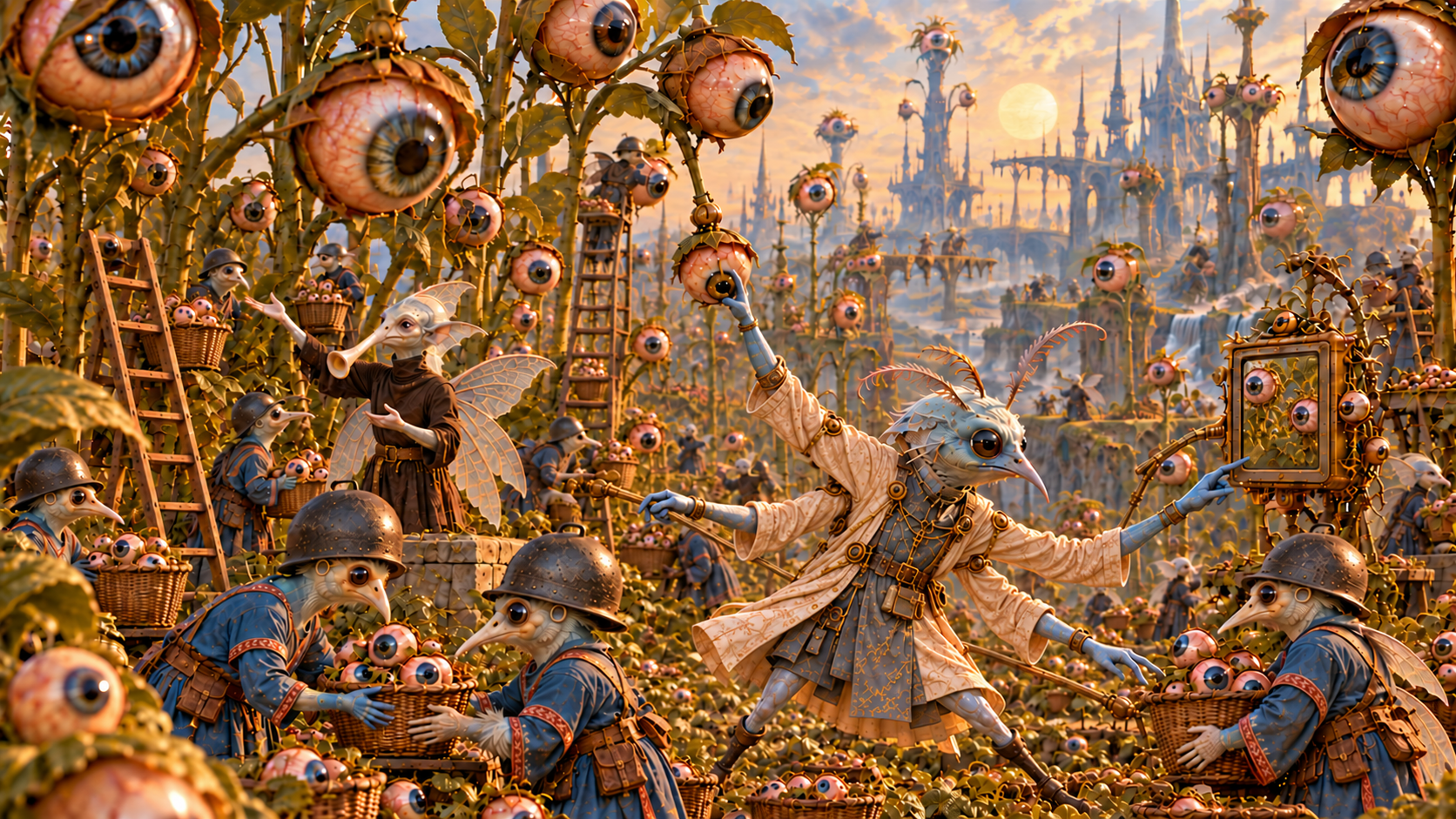
Eyes hang among the leaves, ripe as fruit. But they do not wait silently to be harvested: their gazes follow the beings working among the plants. No step goes unwatched. The Trumpet Creature calls for the harvest and promises visibility. The four-armed Problem Solver organises the process. At the monitor, she watches the numbers rise. The Pot Birds gather the eyes and store them in their baskets. Soon the baskets overflow; the paths disappear beneath the yield. Still, the picking, counting and stacking continue.
As the harvest grows, so does the web of watching eyes. The beings gather eyes while the eyes watch them. The Problem Solver monitors the harvest’s success—and is herself under the garden’s gaze. Attention becomes both a commodity and a means of control: those who want to be seen find themselves caught in the gaze of a system that records every movement.
Everyone acts with good intentions. The Trumpet Creature proclaims a promise, the Problem Solver keeps the process running, and the Pot Birds do not want anything to go to waste. Precisely because the process works, it does not stop. The fiasco lies in the excess: eyes everywhere, ever greater visibility—and ever less freedom to escape the gaze.
Chapter II — The Parliament of Closed Ears
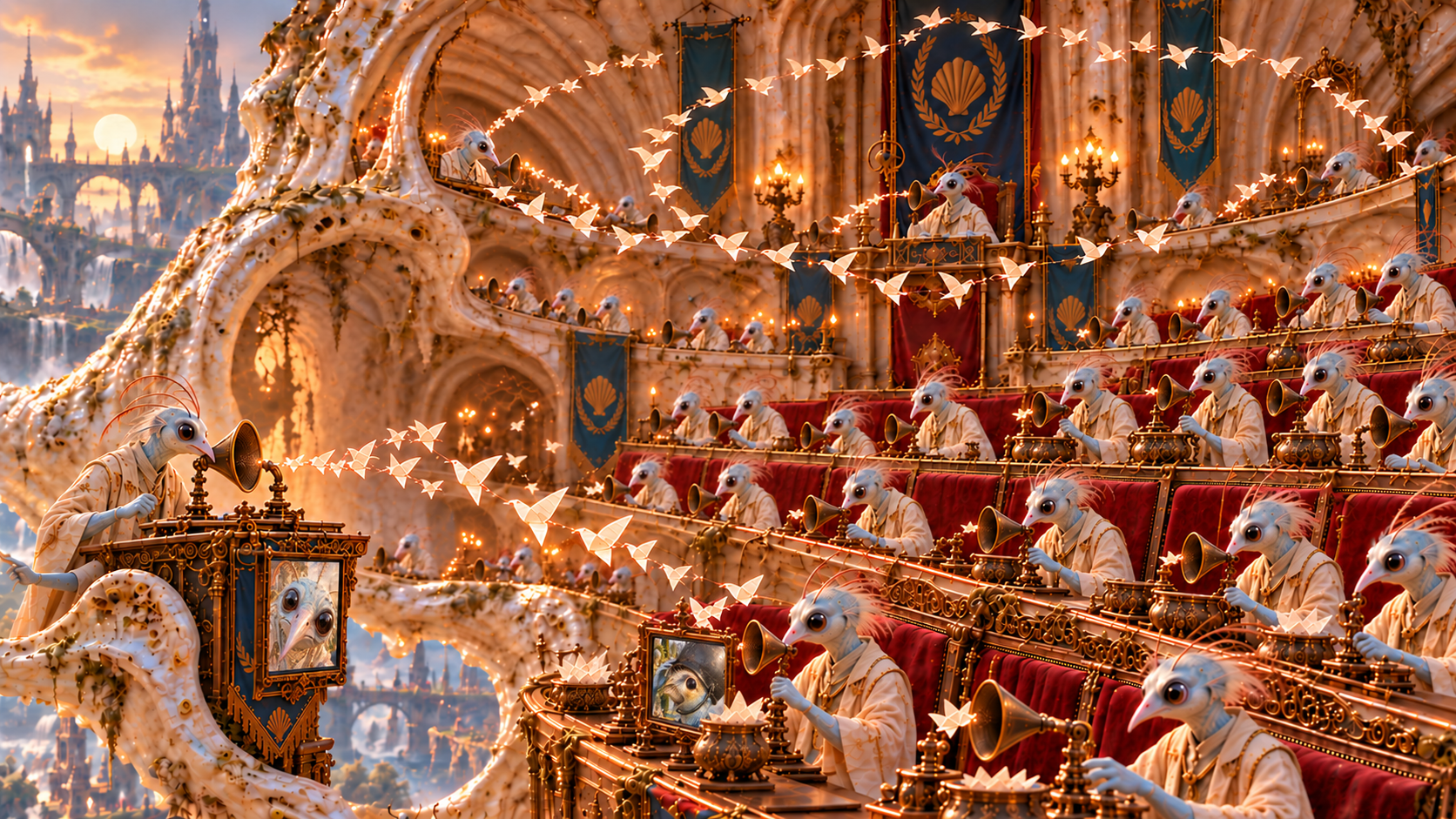
The Parliament of Closed Ears depicts an assembly in which communication is constantly organised, yet loses its power to connect. The chamber is shaped like a giant ear. Antique mechanical speech funnels stand at the lecterns. The delegates speak into them; their words turn into small birds that fly through a central filter. It sorts them and sends them back to their senders. The messages do not reach the others; they return as an echo of the speaker’s own voice.
Only Problem Solvers sit in the parliament. This does not mean a single character, but a diverse group of members of the same species. They differ in age, posture and appearance, but share the same social function: they organise processes, evaluate information and put solutions into practice. The parliament thus appears as a closed administrative space, occupied only by those who organise the process and keep it running.
Two small monitors placed opposite one another show live images of the delegates. They seem to offer a view of the other person, but ultimately return the viewer’s own image. Together with the filter, they form a closed feedback loop: each person increasingly sees and receives their own perspective. Communication is not switched off; it continues, mediated, sorted and personalised by technology. This can create the impression of an exchange even when no genuine encounter with a different position takes place.
The scene refers to a present in which platforms, recommendation systems and personalised information channels increasingly shape which voices are visible and which perspectives reach people. The filter in the parliament evokes echo chambers and filter bubbles. At the same time, the scene reaches beyond digital media to any institution that organises information in ways that weaken dissent or return it to its point of origin. The paths taken by the word-birds make this mechanism visible: the problem is not the volume of communication, but its closed circulation.
The Problem Solvers are not portrayed as evil or indifferent. They speak, examine and organise with the intention of enabling a functioning debate. The fiasco arises precisely because the system appears to fulfil its purpose reliably: it processes every statement but no longer allows them to become an encounter with others. The parliament becomes a place where everyone can speak—and no one truly listens.
Chapter III — The Factory for Enhanced Beings
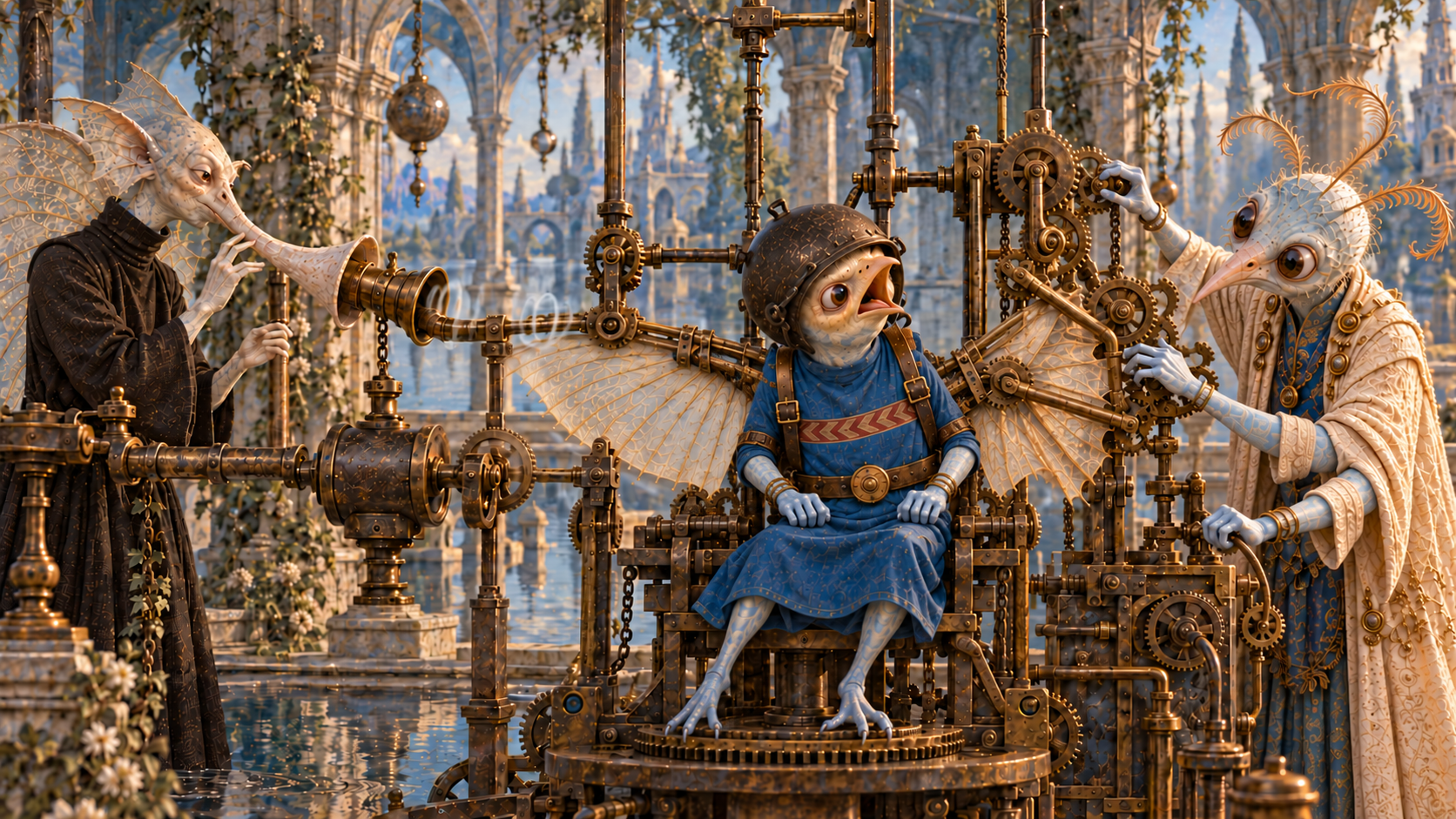
The Factory for Better Beings depicts a factory that aims to help its inhabitants expand their capabilities. The three species acquire new abilities: stronger wings, sharper perception, or mechanical devices that support their movements. At first, these changes seem useful. They promise to make tasks easier and give the beings greater scope to act.
At the centre of the scene, the Problem Solver works on a device designed to make these enhancements possible. A support is fitted to the Pot Bird’s wings, while the Trumpet Creature sends a call into the machine. The sound is translated into mechanical vibrations, setting the apparatus in motion. What begins as a signal of support can repeat itself and become a command. An individual enhancement thus turns into an automated process.
The new abilities work. The beings can accomplish more, react faster and take on further tasks. But the factory treats this increased capacity as the new normal. As soon as an ability becomes available, it is factored into the workflow; as soon as a being can do more, more is expected of it. The apparatus assigns new tasks without asking whether the beings want to take them on. Their bodies become more capable as their freedom to choose diminishes.
The tableau reflects a present in which technology and self-optimisation promise to extend human abilities. It asks what happens when support is no longer guided by individual needs, but by measurable performance. An enhancement can then become an expectation—and an added ability can turn into a permanent obligation.
The beings act neither maliciously nor indifferently. The Problem Solver wants to help, the Trumpet Creature provides the helpful signal, and the Pot Bird accepts the enhancement. The fiasco arises precisely because the apparatus fulfils its purpose: it makes the beings more capable until their increased capacity begins to work against their freedom.
Chapter IV — The Enemy That Grows Out of Data
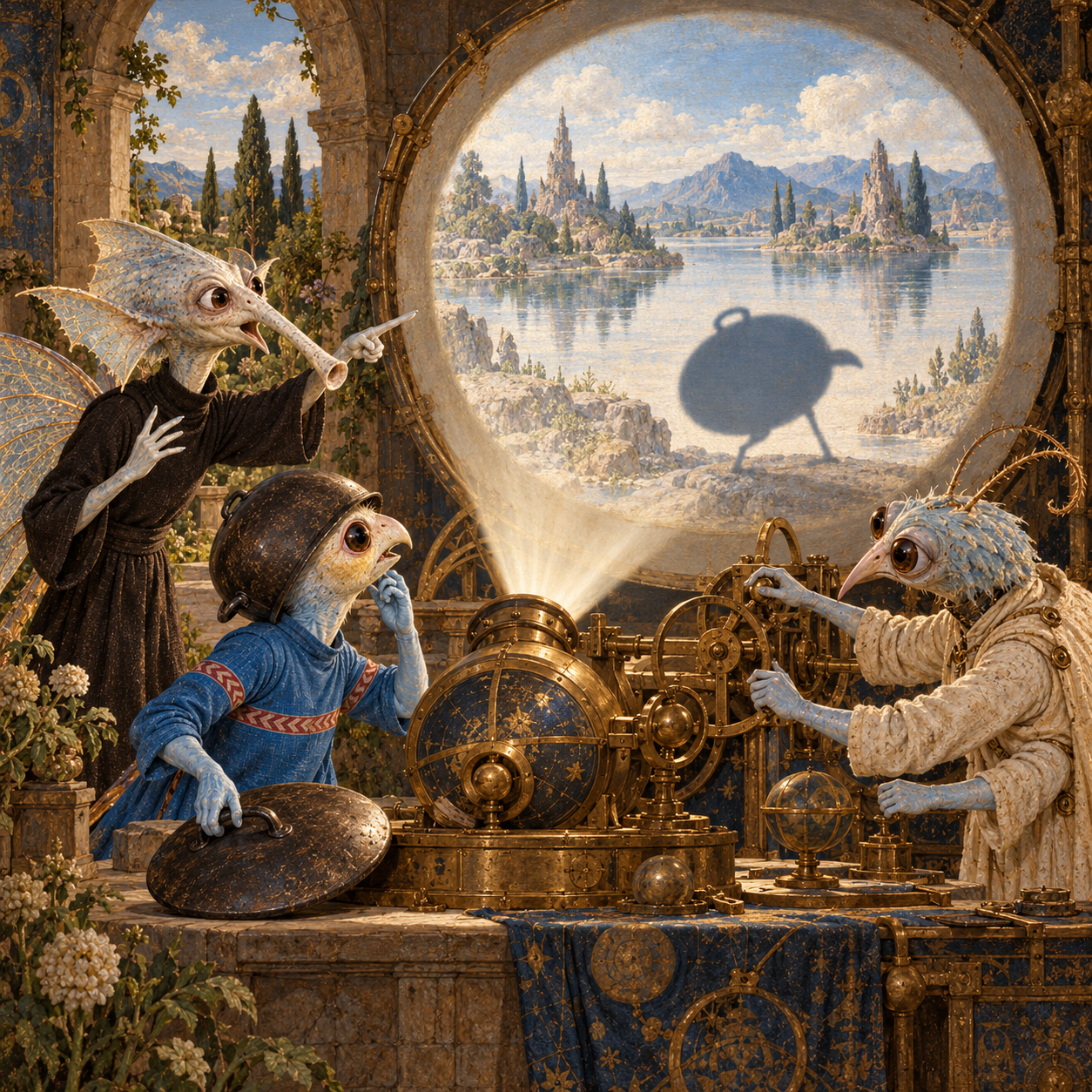
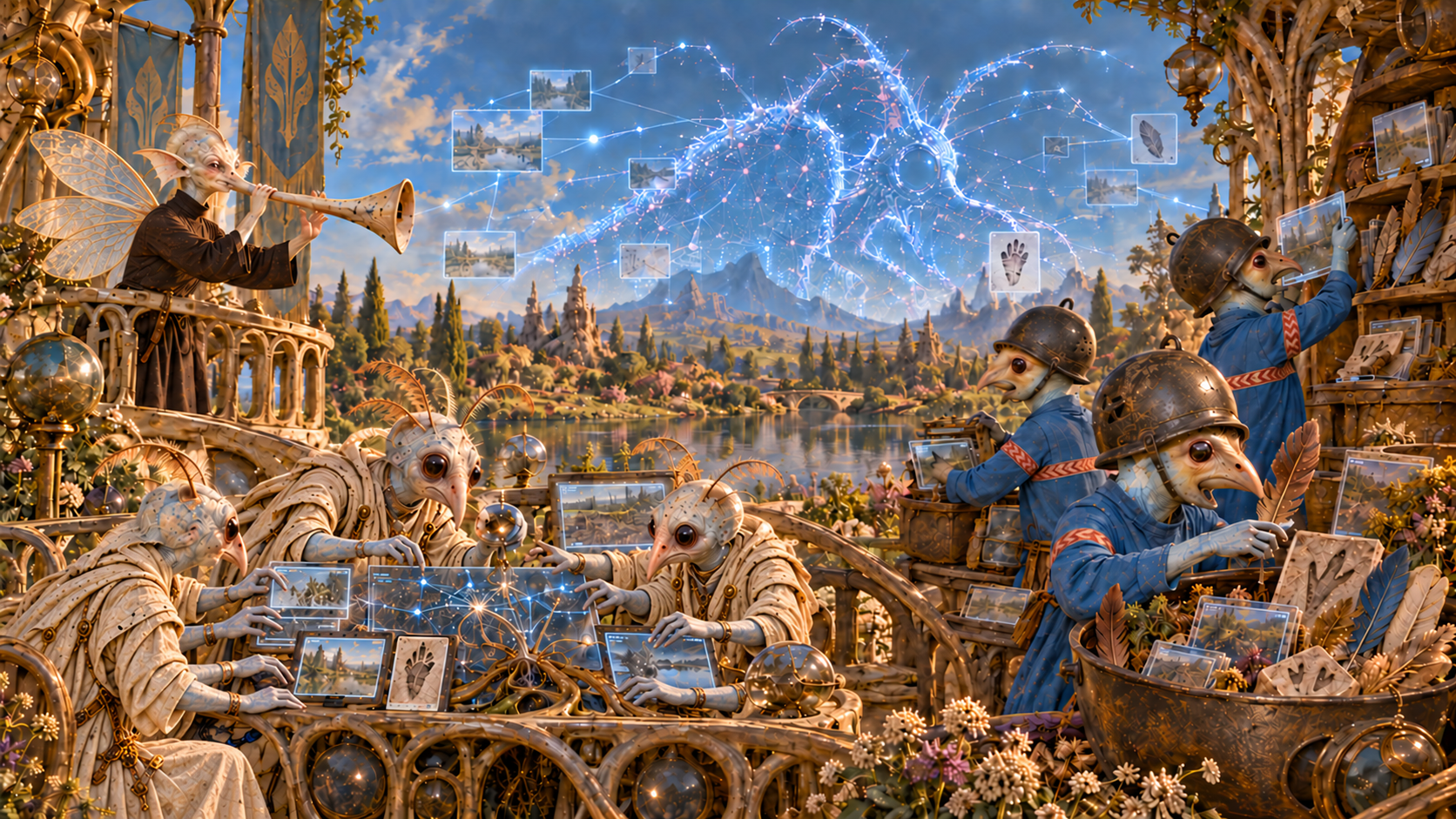
Points, shadows and fleeting movements gather in the sky. A screen brings them together, draws lines between them and gradually traces the outline of an enemy. Yet out in the landscape there is nothing but wind in the grass, a few footprints and a bird taking flight. The threat has no form—until the projection gives it one.
The Trumpet Creature announces the danger. The Problem Solvers examine the displays, add data and adjust the prediction system. The Pot Birds carry the collected traces, notes and found objects to their archive. Each action seems reasonable: observe more closely, check more carefully, be better prepared. But every response leaves new traces. The system reads them as confirmation and makes the enemy larger.
The threat grows out of the measures intended to prevent it. The creatures direct their attention towards an image composed of their own data and decisions. The more determinedly they prepare to face it, the more real the phantom appears. In the end, an entire system is locked in a struggle with a danger it has brought into being itself.
Chapter V — The Machine for the Abolition of Chance
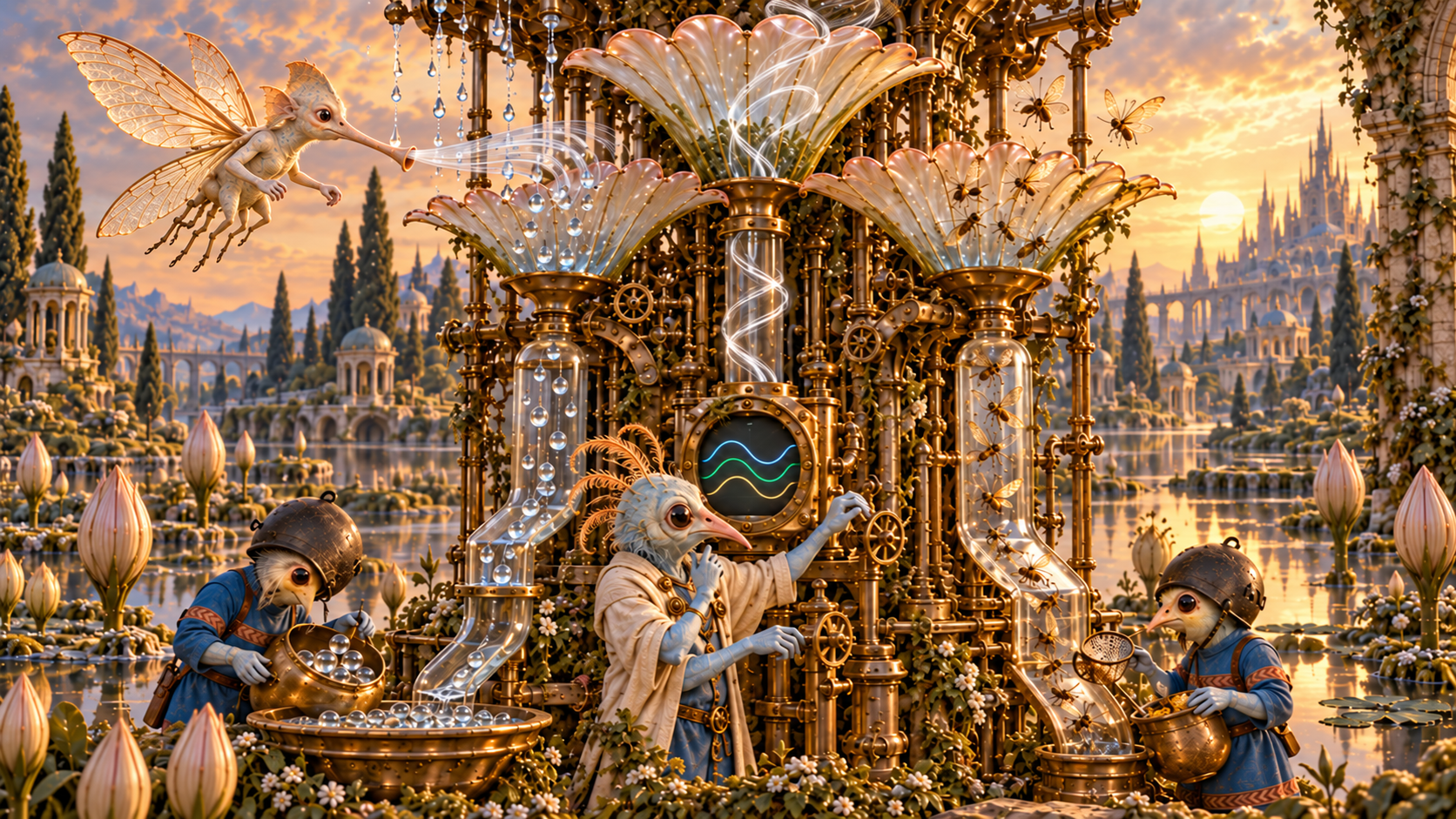
A large organic apparatus promises to respond to heat, drought and unpredictable weather. It catches raindrops, guides currents of air through glass channels and sorts insects into separate chambers. At its centre, a monitor displays smooth, regular measurements. The apparatus seems to have made the weather predictable.
The three hybrid beings keep the process running. The Problem Solver checks the display and adjusts the mechanism. The Pot Birds collect raindrops and insects, preserving them in their vessels. The Trumpet Creature flies above the apparatus. Its call and movement feed air into the machine; its wings become part of a system designed to regulate natural currents.
But this order comes at a price. The flowers remain closed, the water barely moves and the air seems to have lost its changing directions. The measurement curves show stability, but they cannot tell us whether the ecosystem is still alive. The machine confuses a steady reading with a healthy state.
The tableau reflects the desire to manage the effects of climate change and extreme weather through increasingly precise forecasts and technological control. It asks what is lost when every deviation is treated as a disturbance. All three beings act for understandable reasons: they want to protect, organize and preserve. The fiasco unfolds because the machine fulfils its purpose so successfully that it eliminates the unpredictability on which living systems depend.
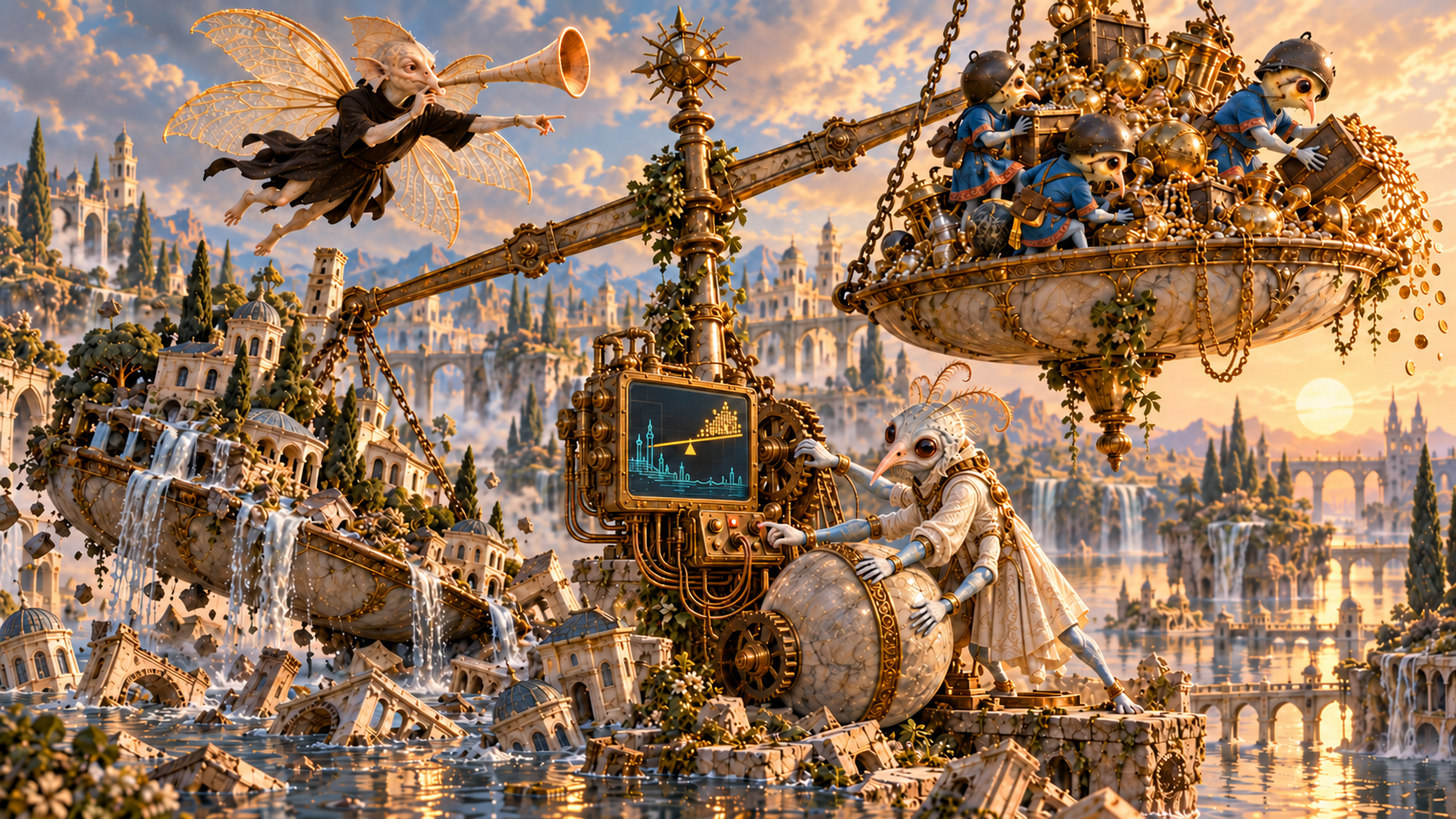
Chapter VI — The Weight of Wealth
A monumental scale falls out of balance. On one side, pots filled with gold coins are piled high; on the other, houses and gardens stand on a narrow platform. Under the growing weight, one side sinks lower and lower while the other hangs suspended above the city.
The Pot Birds add more coins to the heavier side. They want to secure the wealth they have collected. The Problem Solver works at a console connected to the scale’s gears. A screen tracks the distribution of wealth and shows how it is becoming concentrated on the golden side. The Problem Solver searches for a counterweight and tries to rebalance the scale.
The Trumpet Creature flies above the tilting structure, proclaiming that the scale is balanced. Its message sustains the existing order even as houses and gardens begin to slide. The computer system also provides figures and measurements. It can make inequality visible, but it cannot correct it on its own.
Everyone acts for understandable reasons: the Pot Birds want to preserve what they have gathered, the Problem Solver tries to correct the imbalance, and the Trumpet Creature announces the established order. The fiasco unfolds as wealth continues to accumulate while its consequences fall on the other side of the scale. Wealth grows heavier—and the world that bears it begins to slip.