HYDROLOGICAL CIRCLES
ARTISTIC RESEARCH
How can landscape enter an image without being represented?
Hydrological Circles does not answer this question through views of the Mongolian Gobi Desert. Ikh Gazriin Chuluu appears neither as panorama nor as topographical motif. Instead, the place becomes visually legible where its specific environmental conditions influence the behaviour of a limited quantity of water and leave material traces in the paper.
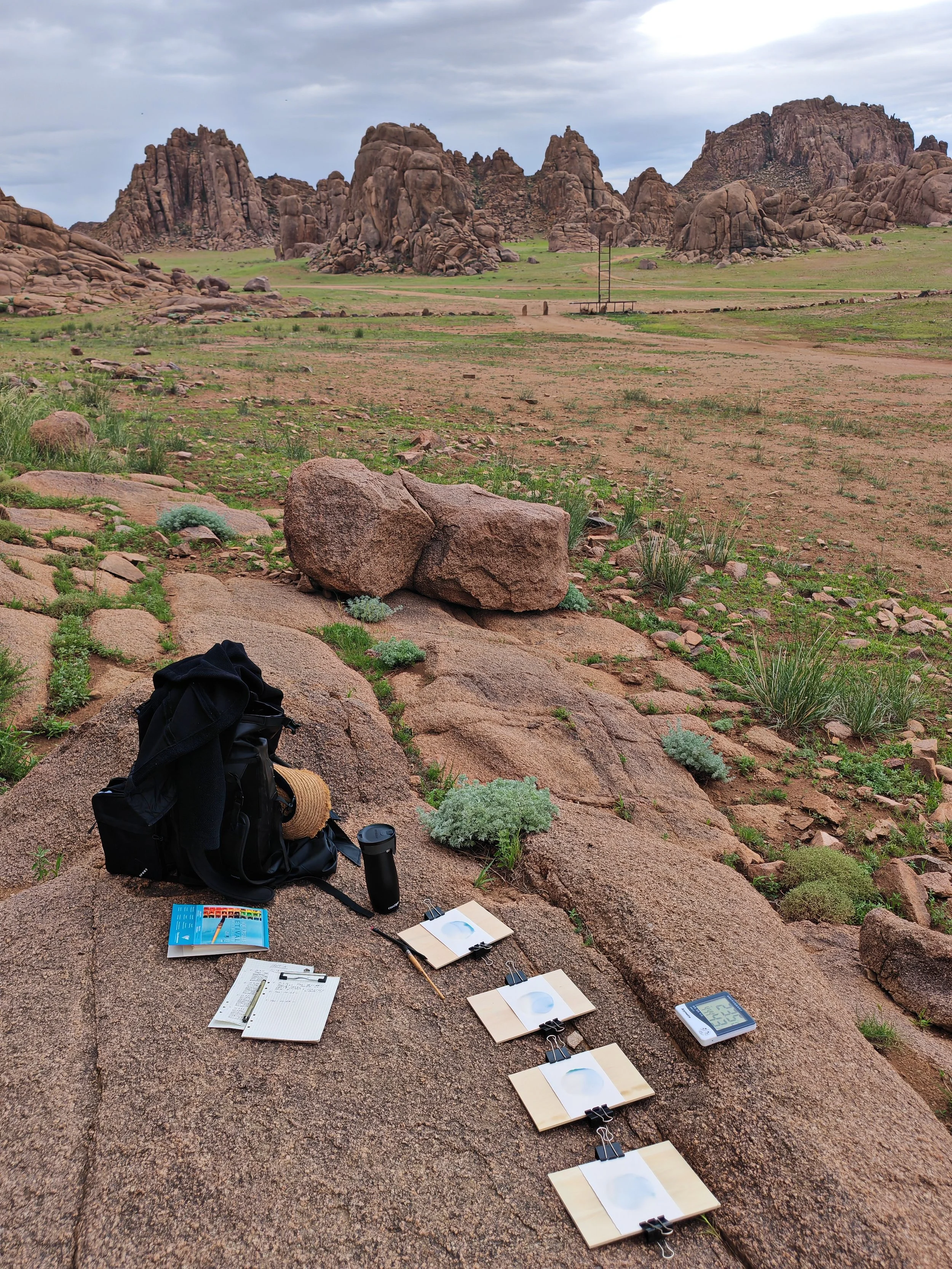
The series was created during a stay in Ikh Gazriin Chuluu, a region characterised by granite formations. It brings together watercolour painting, artistic field research, time-based processes and elements of scientific documentation. Its experimental arrangement follows a repeatable protocol without claiming the controlled conditions of a laboratory. The project’s wider questions emerge from this methodological tension between a defined procedure and an open field situation: How do site-specific environmental parameters shape the behaviour of a limited quantity of water? And how do these influences make both the site and the local material time arising within the process perceptible?
A comparable artistic action was repeated at seven locations under changing conditions. This resulted in 46 field studies. Forty-three experiments reached a documented drying endpoint; three were interrupted by heavy rain.
The purpose of repetition was not to produce identical images. Instead, it established a shared point of departure against which differences could become visible. Although paper format, pre-moistening and application method remained largely constant, the works developed different forms of expansion, pigment concentration, edge formation and drying duration.
In these works, landscape is neither background nor passive setting. It participates physically in the process of formation. Temperature, humidity, wind, light and precipitation interact with water, pigment and paper. The result is not a representation of the place, but a material consequence of its effects. The circles are therefore both images and events, fields of inquiry and residues of a time-limited process.
-
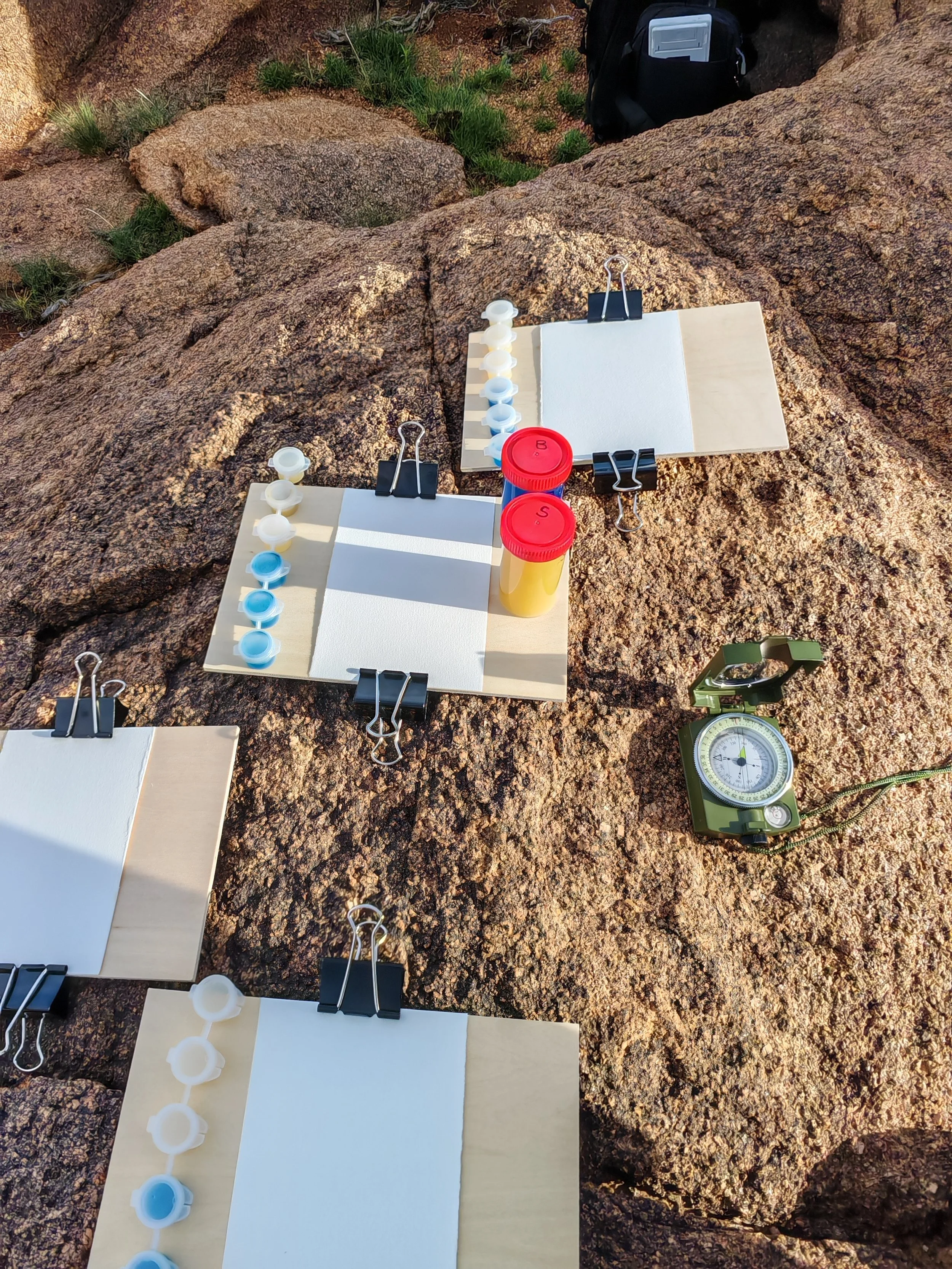
The basic action remained largely the same in all experiments. A sheet of watercolour paper was placed horizontally on a portable support and pre-moistened with unpigmented water within a circular area. Defined quantities of two pigmented water suspensions were then applied using two syringes.
The colours used were Phthalo Blue 407 and Light Ochre 600 from the GERSTAECKER Aquarell Studio range. The manufacturer describes both colours as transparent and highly lightfast. Because publicly available product information specifies neither the exact Colour Index pigments nor their proportions by mass, the materials are documented by manufacturer, product range, colour name, colour number and order number. No more detailed chemical composition is claimed. For each colour, a nominal 20 millilitres of water was prepared in separate vessel. Colour was picked up with a brush from the moistened pan and introduced into the water by three complete brush transfers. The mixture was then stirred until a visually even, fluid suspension had formed.
Because the transferred mass of paint was not weighed, the concentration of pigments and binders cannot be retrospectively determined in milligrams per millilitre. The mixtures must therefore be described as procedurally standardised but not gravimetrically quantified pigment suspensions. Their comparability rests on the same nominal volume of water, the same number of brush transfers and a largely consistent mixing procedure.
The paper remained at each location until no visible moisture could be detected. The beginning and end of the process were recorded together with the quantity of water, air temperature, relative humidity, wind direction and force, light and weather conditions, elevation, geographical position and special events. The documented endpoint does not denote an isolated evaporation time. Water did not only evaporate from the surface: it was also absorbed by the paper, transported within the fibres and subsequently released back into the atmosphere. What was measured was therefore the drying duration—the interval between the application of the pigmented suspensions and the moment at which no visible moisture remained. This moment had to be determined by repeated observation. The protocol thus did not merely document the event; it also defined its beginning, its completion and the deviations regarded as relevant.
The resulting forms emerged from the interaction of three levels of conditions:
• Site-specific environmental conditions included air temperature, relative humidity, wind, light, precipitation, elevation and the microclimatic exposure of the site concerned.
• Material conditions comprised the properties and pre-moisture of the paper, the quantity of water, the procedurally produced composition of the pigment suspensions, pigment distribution, and the absorption and transport behaviour of the paper fibres.
• Procedural conditions included the horizontal positioning of the support, pre-moistening, the preparation and application of the pigment suspensions, and the determination of the drying endpoint.
The procedure was therefore standardised in its fundamental actions, but not fully controlled. While material quantities, application method and documentation structure were largely fixed, atmospheric and microclimatic conditions remained variable. This very difference between methodological prescription and open field situation forms the basis of the project.
-
The project is situated within artistic research because artistic practice itself is used as a mode of inquiry. Knowledge does not precede the work and then become represented visually. It is produced through the action, the response of the materials and the encounter with the concrete conditions of the site.
The series is therefore not a typology of perfect circles. It is a morphology of the processes through which circles lose, shift and renegotiate their boundaries. The prescribed form is the point of departure, not the desired result. The study asks how a comparable experimental arrangement produces different material states under changing environmental conditions.
In this context, artistic research refers to inquiry in which questions, methods and insights are inseparable from artistic practice. The watercolours are not merely the results of an already completed investigation. They are also the media in which that investigation takes place. Water, paper, pigment, location, time measurement and documentation together form a research apparatus.
In Hydrological Circles, scientific procedures are used as an artistic apparatus for producing situated knowledge. At the same time, the project preserves the incompleteness and contingency that controlled laboratory procedures ordinarily seek to reduce.
The knowledge produced is situated: it arises within a concrete field situation in which the person carrying out the experiment is part of the arrangement and helps determine selection, execution, observation and documentation. The results are therefore traceable, yet bound to the particular environmental, material and procedural conditions.
The series makes no claim to unequivocal cause-and-effect relationships. Measurements describe selected conditions, while the images preserve their material consequences. The two levels are connected but cannot be fully translated into one another. This tension between the measurable and the materially effective forms a central space of knowledge within artistic research.
Five Core PropositionsFive interconnected artistic propositions can be derived from the experimental arrangement.
1. Landscape Enters the Image without RepresentationThe Gobi Desert is not represented as a view, panorama or topographical motif. It is present through its physical effects. Temperature, humidity, wind, light and precipitation influence the behaviour of the water and thereby the formation of the images. Landscape appears not as a view but as a condition. Its presence lies in what it materially helps to cause.
2. Repetition Produces Difference
The repeatable protocol does not serve to produce identical circles. It establishes a comparable point of departure against which differences become visible. Standardisation does not eliminate singularity; it heightens its perceptibility. The series therefore does not examine the success of an ideal form. It follows how a prescribed form changes, opens, shifts or dissolves under varying conditions.
3. Water Produces Local Material Time
Drying duration translates atmospheric and material conditions into a temporal interval. This time is not recorded only as a number of minutes. It is also inscribed in pigment movements, edge formation, sedimentation, pale areas and overlays. The individual sheets thereby become records of atmospheric time. They show not an abstract, evenly flowing time, but a duration produced through the concrete relationship between water, paper and environment.
4. Deviations Belong to the Work
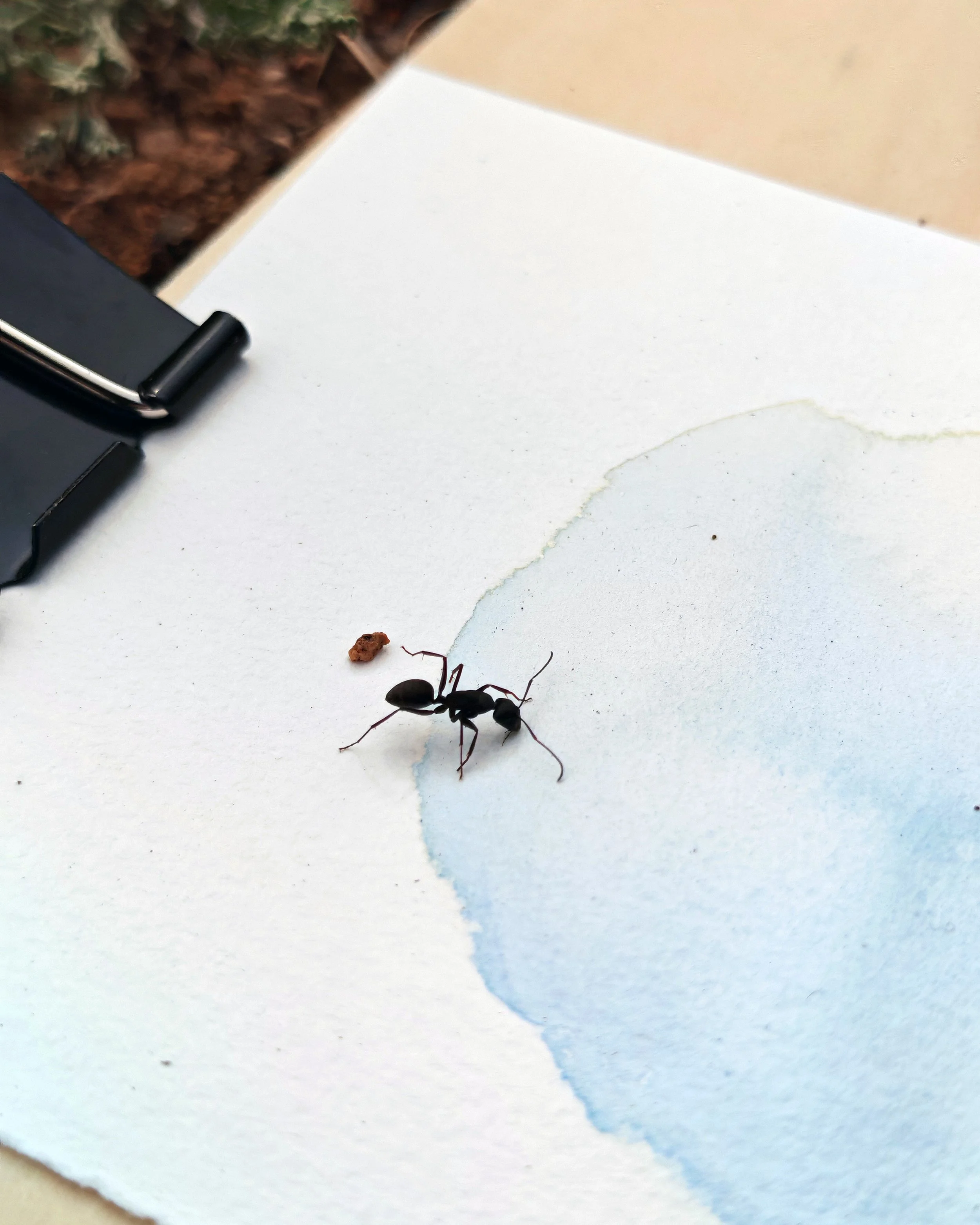
Rain, insect contact, incline and interruption are not treated as external disturbances that must be removed from the series. They reveal the limits of authorial and methodological control. The three experiments aborted by heavy rain also produce knowledge. They show that an experiment does not become relevant to inquiry only when it reaches its intended endpoint. The failure or interruption of a protocol can likewise disclose its conditions and limits.
5. Knowledge Arises Relationally
The project’s insight lies neither solely in the image nor solely in the data set. It arises in the relationship between protocol, environment and material trace. The protocol creates a methodological order. The environment changes its course. The trace retains part of that change. Situated knowledge arises where these three levels are read together without erasing their differences.
Research Fields as LensesThe series can be considered from different scientific perspectives. Evaporation physics and thermodynamics ask about the relationship between water quantity, temperature, humidity and drying duration. Radiation research directs attention to the effect of direct sunlight. Investigations of gravity and flow concern the consequences of incline for duration and morphology. From a hydrological perspective, each sheet temporarily becomes a small reservoir that absorbs, distributes and then loses water.
Disturbance ecology draws attention to heavy rain and non-human contact. Geographical perspectives show that coordinates alone do not fully define a place: even nearby locations can produce different microclimatic profiles. Time geography, finally, opens the question of how spatial conditions generate their own temporal trajectories. These perspectives are used within the project as research lenses. They help to question different aspects of the material without subordinating the series to a single discipline. Hydrological Circles does not replace physical, climatological or hydrological research. Rather, it produces insights that arise precisely from the conjunction of measurement, material experience, visual form and situated action.
The data do not support a simple rule according to which higher temperatures, lower humidity or direct sunlight necessarily lead to shorter drying durations. Comparable quantities of water produced a broad spectrum of durations and appearances. Some relationships require closer investigation; others resist unequivocal attribution because of the complex field conditions.
-
Water was chosen as an artistic material because it responds sensitively to its immediate environment. Temperature, relative humidity, wind, light and precipitation influence its spread and drying. At the same time, the paper’s pre-moisture and absorbency, the quantity of water applied and the composition of the pigment suspensions affect the process.
As the water is absorbed by the paper and released back into the atmosphere, it carries pigment particles through the fibres. Once the visible moisture has disappeared, pigment edges, deposits, pale areas and deformations remain as material traces of its temporary presence.
A total of 60 millilitres of water was carried from Ulaanbaatar for the fieldwork. Three portions were planned: 20 mL of unpigmented water for pre-moistening, 20 mL for the Phthalo Blue suspension and 20 mL for the Light Ochre suspension. Pre-moistening the 46 sheets used 13.8 millilitres of unpigmented water. A further 32.4 millilitres of pigmented suspensions were applied, comprising 16.2 millilitres each of Phthalo Blue and Light Ochre. Thus, 46.2 millilitres of liquid were applied in the experiments. The remaining 13.8 millilitres comprise spilled liquid, residues in the vessels and unused remainders. Because these portions were not documented separately, they are reported collectively as the quantity not applied.
The limitation of the water became a real material condition of the project. The extent of the series resulted not only from a predetermined number but from the interaction of planning, actual consumption and the quantity remaining. The spill was not subsequently removed from the project’s history, but incorporated into its structure as an unplanned material change.
The small quantity of water also stands in deliberate relation to the spatial expanse of the Gobi. Its effects are concentrated within a field of investigation only a few centimetres across. The water functions as a sensitive probe whose movement, absorption and drying respond to local atmospheric and material conditions. For the duration of each experiment, the paper becomes part of a small hydrological system: it absorbs water, distributes it through its fibres and releases it again. The image emerges as the material trace of a liquid that was present only temporarily.
-
Within Hydrological Circles, the circular form fulfils several interconnected functions. As a recurring field of investigation, it constitutes a methodological constant that makes changes under varying environmental and material conditions comparable. At the same time, it refers to the temporal structure of the experiment: each study begins with the application of pigmented water and ends at the defined drying endpoint. The circle therefore becomes both a field of measurement and a temporal form.
This function belongs to an extensive art-historical field of reference. In both European and East Asian artistic traditions, the circle is associated with ideas of wholeness, cosmos, recurrence, concentration and transcendence. In Hydrological Circles, however, it does not serve as the outline of a represented object, but as a field in which forces, movements and material changes become visible. The geometric proposition retains the traces of a time-limited process.
Within the Mongolian context, an additional formal relationship emerges with the ger, the traditional circular dwelling. Its structure organises inhabitable space around a centre and connects geometric order with movement and community.
Several layers of meaning thus overlap within the series: the circle is a field of measurement and a body of water, a clock form and an image format, a hydrological cycle and an architectural ground plan. Yet its closure remains provisional. Water crosses the prescribed boundary, accumulates, forms asymmetrical trajectories or separates into smaller bodies of liquid; pigments migrate, concentrate and sediment along irregular edges.
The circle thus becomes the site of distributed authorship. The initial form is set artistically, while its specific appearance is co-determined by water, pigment, paper, atmosphere and time. Repetition therefore does not produce identical images, but a common framework within which differences become visible.